


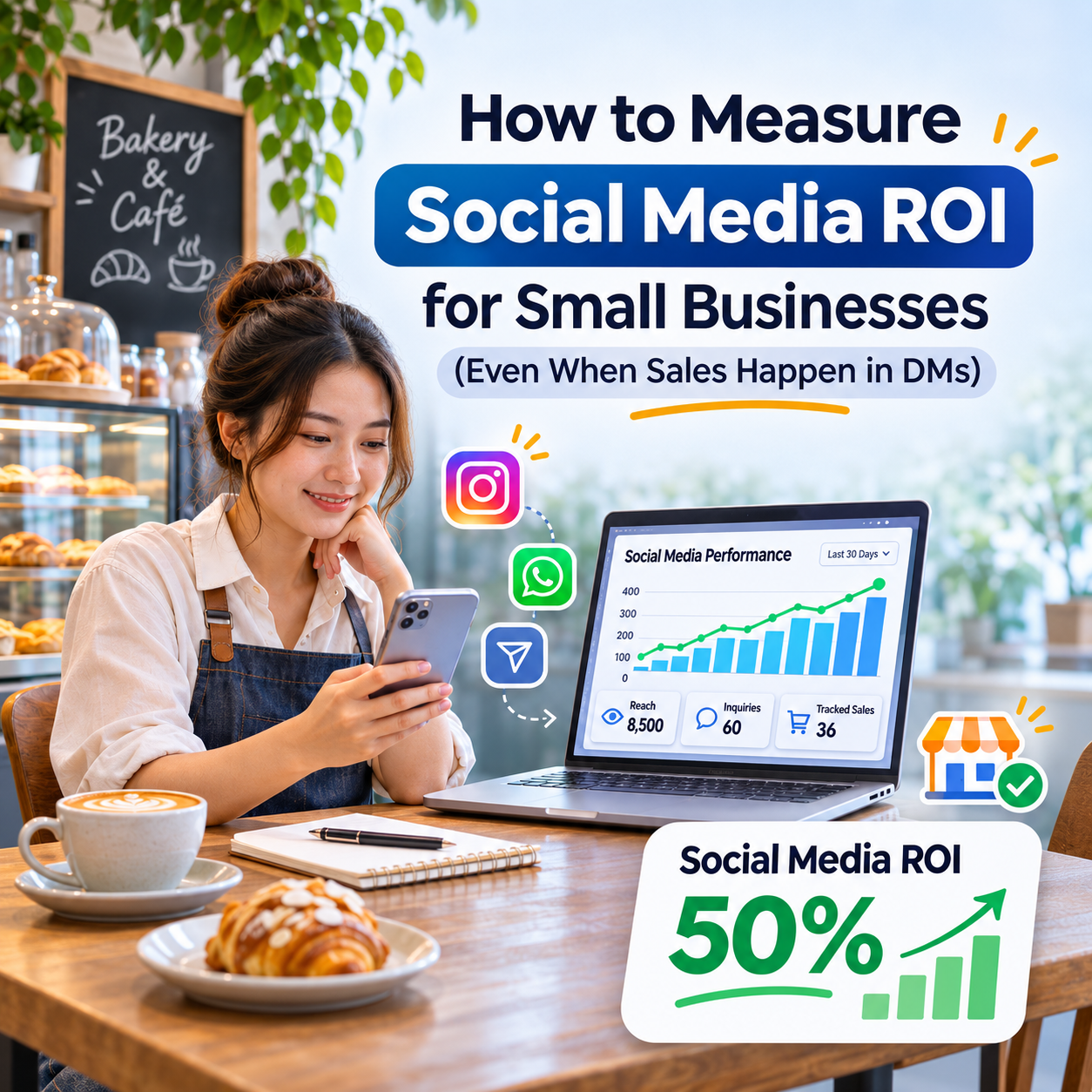

Why Social Media ROI Is Harder to Measure Than It Looks
Your Instagram posts are getting likes, your Reels are reaching new audiences, and customers are sending messages asking about your products. Everything seems to be working. But here’s an important question: Is your social media activity actually making your business money?
For many small business owners, measuring social media ROI (Return on Investment) is more complicated than counting likes, followers, or website clicks.
Imagine you own a small café. A customer discovers your latest promotion through an Instagram Reel, checks your profile, and sends a direct message asking about the menu. A few days later, they visit your café and make a purchase. Your social media content helped bring in that customer, but Instagram’s analytics may never show the actual sale.
The same challenge applies to online shops, restaurants, beauty salons, and service businesses. Customers might discover a product on Facebook, ask questions through WhatsApp, and complete their purchases through bank transfers or in-person visits.
These interactions create a gap between social media performance and actual business results.
While social media platforms provide valuable metrics such as reach, impressions, engagement, and clicks, they don’t always tell you how much revenue your marketing efforts generate or whether that revenue justifies your investment.
And that’s why understanding social media ROI matters.
Measuring ROI isn’t simply about identifying your most popular posts. It’s about understanding how your social media efforts contribute to customer acquisition, sales, and business growth.
The good news? You don’t need expensive analytics software or a complicated tracking system to get started.
With a few practical methods, even small businesses that rely on Instagram DMs, WhatsApp conversations, or offline sales can begin measuring their social media ROI more effectively.
Do you struggle with managing multiple social media platforms for your brand's presence?
The Sociosight app can help you simplify the process and save you time. With Sociosight, you can publish, schedule, and monitor posts and engage with your followers across multiple social media platforms, all from one dashboard.
Get started today with a free sign-up!
Register Now for Free

In this guide, we’ll explore how to calculate social media ROI, track conversions that happen outside social media platforms, and use those insights to make smarter marketing decisions.
What Is Social Media ROI?
Social media ROI (Return on Investment) measures the financial value your business generates from social media marketing compared to the amount you spend on it.
In simple terms, social media ROI helps answer one important question: Are your social media efforts bringing in more value than they cost?
For small businesses, this matters because social media marketing is rarely free, even when you’re not running paid advertisements.
Creating content takes time. Designing graphics, producing videos, writing captions, managing social media accounts, and responding to customer inquiries all require resources. If you’re paying for advertising, content creators, or social media management tools, those expenses add up too.
Understanding your social media ROI allows you to evaluate whether those investments are contributing to actual business growth.
Table of Contents
Social Media ROI vs. Engagement: What’s the Difference?
One of the biggest mistakes businesses make is assuming that high engagement automatically means a successful marketing campaign.
Imagine two Instagram posts from a local bakery.
The first post is an entertaining Reel that receives 20,000 views and hundreds of likes. People enjoy watching it, but very few ask about the bakery’s products.
The second post is a simple photo promoting a weekend cake bundle. It receives only 1,500 views, but generates 15 inquiries and five confirmed orders.
Which post performs better?
That depends on your objective.
The first post may be successful at increasing brand awareness, while the second creates measurable sales opportunities.
This is why social media ROI should be evaluated alongside engagement metrics, rather than treating them as the same thing.
A strong social media strategy includes different types of content for awareness, engagement, and conversion. If you’re unsure how to balance these objectives, our guide on content planning tips for social media management explains how to connect your content strategy with specific business goals.
What Counts as a Return from Social Media Marketing?
When measuring social media ROI, businesses often focus exclusively on immediate sales. However, social media can contribute to business results in several ways.
These include:
- Direct sales: Purchases made after someone clicks a social media link or responds to a promotion.
- Customer inquiries: Potential buyers contacting your business through Instagram DMs, Facebook Messenger, or WhatsApp.
- Lead generation: People requesting quotations, booking consultations, or submitting contact forms.
- Repeat purchases: Existing customers returning after seeing new promotions or content.
- Customer retention: Social media interactions that help maintain relationships and encourage long-term loyalty.
However, there is an important distinction.
Not every business result can immediately be counted as a financial return.
For example, receiving 30 Instagram DMs doesn’t mean your business has generated 30 sales. Those inquiries become financially meaningful when they lead to purchases or when you can estimate their value using reliable conversion data.
Similarly, a customer might discover your business on Instagram but only make a purchase several weeks later after receiving a follow-up message.
This is why connecting social media activity with customer follow-up matters. Our article on email marketing and social media follow-up strategies explores how businesses can turn initial customer interest into stronger relationships and future sales.
Ultimately, measuring social media ROI requires looking beyond what happens inside social media platforms.
You need to understand what customers do after viewing your content, how many become paying customers, and how much profit those sales contribute relative to your marketing investment.
And to do that, you need a clear way to calculate your return.
How to Calculate Social Media ROI
Calculating social media ROI doesn’t have to be complicated. Once you understand how much you’re investing in social media marketing and how much financial value it generates, you can start evaluating whether your efforts are paying off.
The challenge is making sure you’re comparing the right numbers.
Many small businesses calculate their social media return on investment by comparing sales revenue directly with advertising costs. While this provides a useful starting point, it can create an overly optimistic picture if you ignore content production expenses, employee time, and the costs of delivering your products or services.
Let’s break down the calculation.
The Social Media ROI Formula
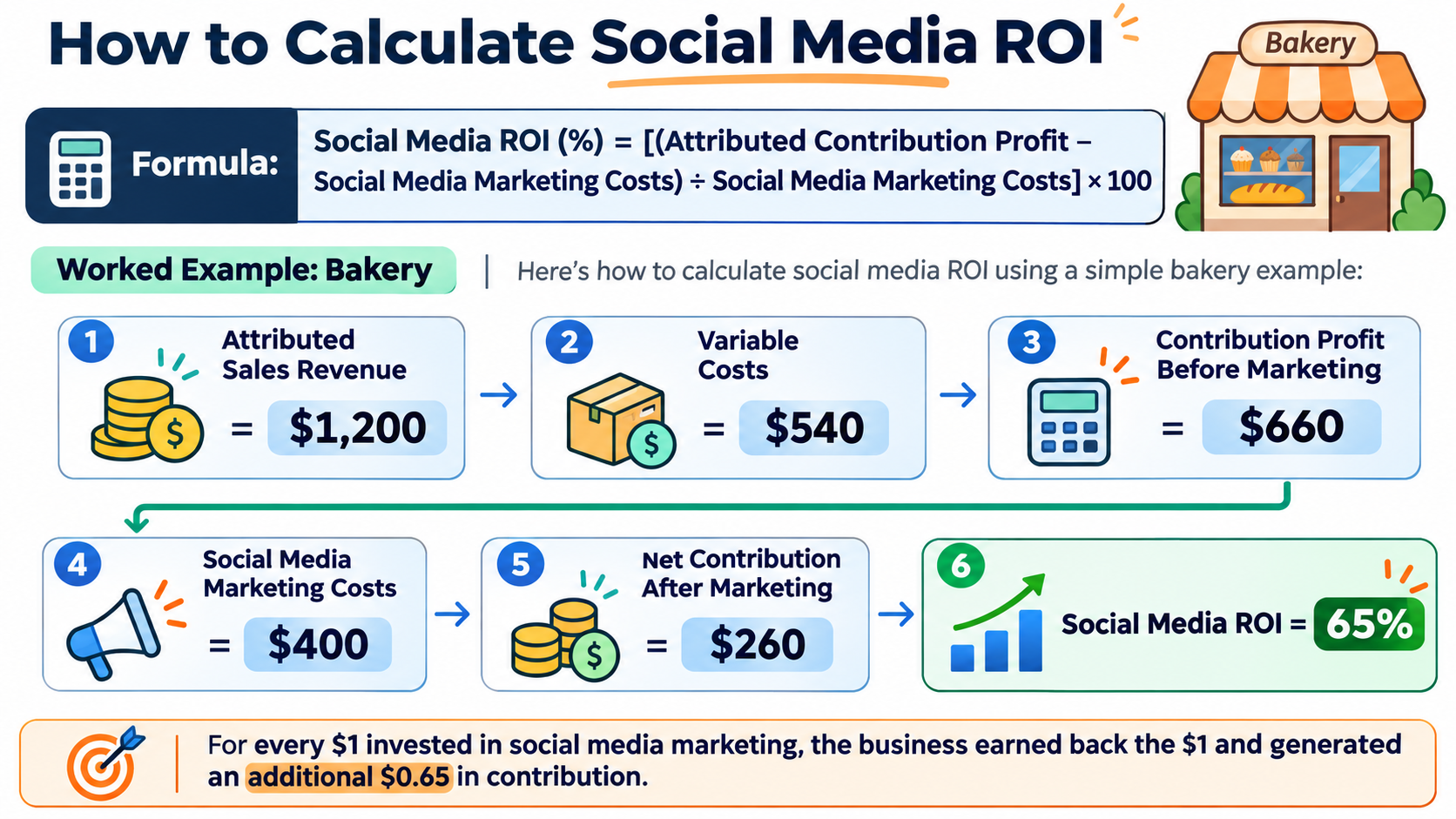
The basic formula for calculating social media ROI is:
Social Media ROI (%) = [(Return − Investment) ÷ Investment] × 100
For a more accurate financial measurement, we recommend using:
Social Media ROI (%) = [(Attributed Contribution Profit − Social Media Marketing Costs) ÷ Social Media Marketing Costs] × 100
In this formula:
- Attributed Contribution Profit: Revenue attributed to social media marketing minus the variable costs of delivering those sales, such as product costs, packaging, or transaction fees.
- Social Media Marketing Costs: The expenses associated with creating, distributing, and managing your social media marketing activities.
A positive ROI means the attributed contribution from your social media efforts exceeds your marketing investment. A negative ROI means the measurable contribution hasn’t covered those costs.
For example, a social media ROI of 50% means your campaign generated an additional $0.50 in net contribution after marketing expenses for every $1 invested.
Keep in mind that this calculation measures financial performance. Social media can also generate long-term benefits, such as brand awareness and customer relationships, that may not immediately appear in your ROI calculation.
What Should You Include in Social Media Marketing Costs?
One common mistake when measuring social media ROI is counting only advertising expenses.
Even if you primarily rely on organic social media content, your marketing activities still require time and resources.
Here are some costs you should consider:
| Expense | Examples |
| Paid advertising | Instagram Ads, Facebook Ads, boosted posts |
| Content creation | Photography, video production, graphic design |
| Content creators | Freelancers, UGC creators, influencer fees |
| Social media tools | Scheduling, analytics, and design software |
| Labor costs | Time spent planning, posting, and managing accounts |
You don’t necessarily need to calculate every expense down to the last cent. For small businesses, a reasonable and consistent estimate is often more useful than trying to create a perfect accounting system.
For example, if you’re using a social media management tool for several accounts or campaigns, allocate an appropriate portion of its subscription cost rather than assigning the entire expense to one campaign.
The important thing is to measure costs consistently so you can compare social media ROI across different periods and campaigns.
Social Media ROI Example: A Small Business Campaign
Imagine a small bakery running a one-month Instagram campaign to promote its products.
The bakery publishes organic content, runs several paid advertisements, and answers customer inquiries through Instagram DMs and WhatsApp.
At the end of the month, the owner reviews the campaign results.
Step 1: Calculate Marketing Investment
| Marketing expense | Cost |
| Instagram advertising | $250 |
| Content creation | $100 |
| Social media tools and allocated labor | $50 |
| Total marketing investment | $400 |
Step 2: Calculate the Financial Return
Suppose the bakery successfully tracks 30 customer purchases attributed to the campaign.
Each customer spends an average of $40.
- Total attributed sales: 30 × $40 = $1,200
- Product and other variable costs: $540
- Contribution profit before marketing expenses: $1,200 − $540 = $660
The bakery generated $660 in contribution profit before accounting for the $400 spent on social media marketing.
Step 3: Calculate Social Media ROI
First, subtract the marketing investment from the contribution profit:
$660 − $400 = $260
This means the bakery earned $260 in net contribution after covering its social media marketing costs.
Next, compare that amount with the original marketing investment:
Social Media ROI = ($260 ÷ $400) × 100 = 65%
The bakery’s social media ROI is 65%.
In simple terms, for every $1 the bakery invested in social media marketing, it earned back that $1 and generated an additional $0.65 in contribution after covering its product costs and marketing expenses.
Here’s a quick summary:
| Campaign result | Amount |
| Revenue from tracked sales | $1,200 |
| Product and variable costs | −$540 |
| Social media marketing costs | −$400 |
| Net contribution after marketing | $260 |
| Social Media ROI | 65% |
This is a hypothetical example. Actual ROI depends on reliable sales attribution, product margins, and the marketing expenses included.
Notice that the bakery generated $1,200 in sales, but its social media ROI was calculated using the profit contribution rather than the full revenue.
That’s because revenue alone doesn’t account for the costs involved in fulfilling those orders.
This distinction is especially important for restaurants, retailers, and other small businesses where product costs can represent a significant portion of every sale.
What If You Can’t Track Every Sale?
In reality, not every customer journey is easy to measure.
Someone might discover your business through an Instagram post, share it with a friend, and visit your store several days later. Another customer might watch multiple Reels before contacting you through WhatsApp.
These purchases may have been influenced by social media, but they won’t necessarily appear in your platform analytics.
Rather than guessing how much revenue social media generated, start by separating your results into two categories:
- Tracked conversions: Sales you can reasonably connect to a particular social media campaign through identifiable links, promotional codes, customer records, or confirmed customer responses.
- Potentially influenced conversions: Sales where social media may have contributed to the customer’s decision, but the connection isn’t sufficiently clear to assign a reliable financial value.
Use tracked conversions as the foundation for your social media ROI calculation, while reviewing potentially influenced conversions separately for additional insights.
This approach won’t capture every benefit your social media activities create. However, it helps you avoid overstating your results and makes your calculations more credible.
Over time, as you improve your tracking methods, you’ll develop a clearer understanding of which campaigns generate real business value.
And that brings us to one of the biggest challenges for small businesses: tracking social media ROI when customers don’t complete their purchases directly through social media platforms.
Why Tracking Social Media ROI Is Difficult for Small Businesses
Social media platforms provide plenty of performance data. You can see how many people viewed your posts, clicked your links, or interacted with your content. But turning those numbers into measurable business results is a different challenge.
For many small businesses, the customer journey doesn’t follow a straight line from social media post to purchase. Customers may discover your brand on one platform, continue the conversation elsewhere, and eventually buy through a completely different channel.
This makes tracking social media ROI more challenging, especially when your business depends on personal conversations, repeat customers, or offline transactions.
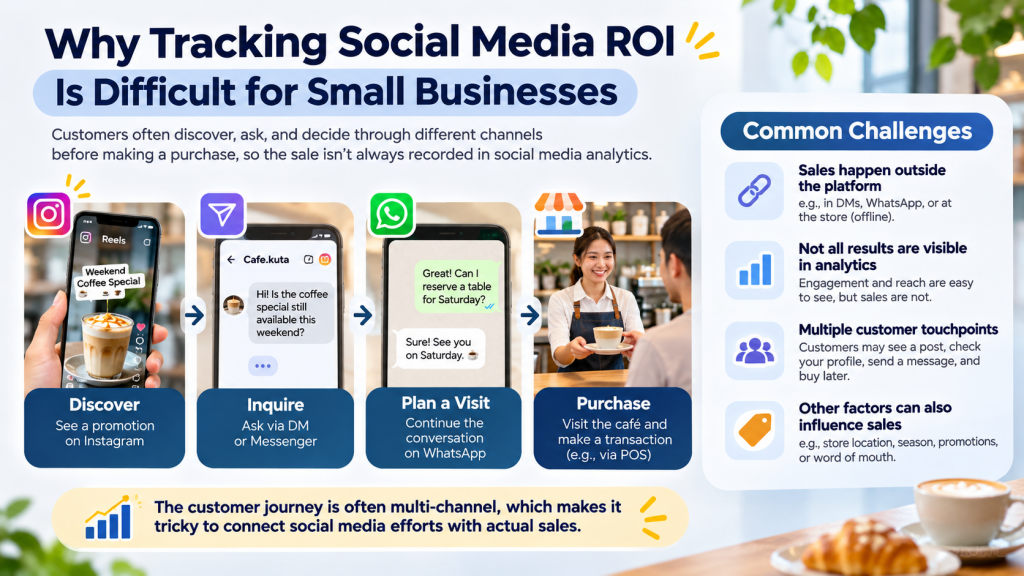
1. Customers Discover Products on Social Media but Buy Elsewhere
Imagine a potential customer discovers your handmade jewelry through an Instagram Reel.
Instead of clicking a website link, they send a direct message asking about prices and available designs. After discussing their preferences, they complete the purchase through WhatsApp and pay by bank transfer.
From Instagram’s perspective, your Reel generated engagement and perhaps a direct message. But the completed sale happened outside the platform.
Unless you record that transaction and connect it to the original interaction, its contribution to your social media ROI may go unnoticed.
This situation is common among businesses that rely on conversations rather than traditional e-commerce checkouts.
2. Offline Sales Are Difficult to Connect to Online Marketing
For restaurants, cafés, salons, and retail stores, social media often influences purchases that happen in person.
A customer might see a restaurant’s Instagram Story featuring a lunch promotion and decide to visit the following day. They order their meal, pay at the cashier, and leave without mentioning Instagram.
The restaurant earns revenue, but there’s no automatic connection between the sale and the Story that influenced the visit.
Without a way to identify where customers discovered the business, owners may underestimate the value of their social media marketing.
This is particularly important for businesses that use social media to attract local customers rather than drive online purchases.
3. Customers Interact with Multiple Channels Before Purchasing
Not every customer buys after seeing a single post.
Someone might discover your business on TikTok, explore your Instagram profile, read Google reviews, and contact you through WhatsApp several days later.
Which channel deserves credit for the sale?
This is known as the marketing attribution problem.
If you assign the entire sale to WhatsApp simply because the final conversation happened there, you may overlook the social media content that initially attracted the customer.
On the other hand, giving full credit to every channel involved would exaggerate your marketing results.
For small businesses, the goal isn’t necessarily to build a sophisticated attribution system. It’s to develop a consistent method for understanding which channels contribute to customer discovery, consideration, and conversion.
4. Engagement Metrics Don’t Always Reflect Business Performance
A post with thousands of views can look impressive in your analytics dashboard. However, high engagement doesn’t automatically translate into sales.
For example, an entertaining TikTok video might attract a large audience outside your target market. Meanwhile, a product-focused Instagram post with fewer views could generate several qualified inquiries from potential customers.
Both posts may provide value, but they serve different purposes.
This is why measuring social media ROI requires more than monitoring likes, shares, and follower growth.
Social media analytics are still valuable. They help businesses understand audience interests, identify successful content formats, and improve future campaigns.
As explained in our guide on social media management tools for Instagram, managing content consistently and using performance insights can help businesses make better marketing decisions.
However, to evaluate financial returns, those insights need to be connected with customer inquiries, conversions, and actual sales.
You Don’t Need Perfect Tracking to Start Measuring ROI
These challenges don’t mean measuring social media ROI is impossible.
They simply mean that businesses need to look beyond the analytics provided by individual social media platforms.
Even a basic tracking system can help you identify patterns, such as which promotions generate the most inquiries, which channels attract paying customers, and how much revenue can reasonably be attributed to your marketing activities.
You may not be able to trace every sale back to a specific post, and that’s okay. The important thing is to distinguish confirmed results from assumptions and improve your tracking process over time.
So how can you actually do this when most of your customers place orders through Instagram DMs, WhatsApp, or other messaging channels?
Let’s explore some practical ways to track those conversations and connect them to measurable business results.
How to Track Social Media ROI When Sales Happen in DMs
Not every small business needs an e-commerce website to generate sales from social media. In fact, many businesses rely on Instagram DMs, Facebook Messenger, and WhatsApp to answer questions, confirm orders, and communicate with customers.
The challenge is that these conversations don’t automatically translate into measurable sales data.
A customer might discover your product through an Instagram Reel, ask about the price in a direct message, and complete their purchase through WhatsApp. If you only look at Instagram analytics, you may see the engagement but miss the revenue generated from that interaction.
Fortunately, tracking social media ROI doesn’t require an expensive customer relationship management (CRM) system. With a few simple methods, you can connect social media conversations to actual business results.
1. Track Leads from Instagram and Facebook Messages
Start by treating customer inquiries as potential sales opportunities rather than just messages.
When someone contacts your business through Instagram or Facebook, record where the inquiry originated and whether it eventually led to a purchase.
For example, imagine a small beauty salon promoting a hair treatment package on Instagram.
During the campaign, the salon receives 40 direct messages asking about the treatment. Of those inquiries, 15 customers book an appointment, and 12 complete their appointments.
Instead of reporting only 40 DMs, the salon can track:
- 40 inquiries generated during the campaign.
- 15 bookings made from those inquiries.
- 12 completed appointments.
- 30% inquiry-to-customer conversion rate.
These numbers provide a clearer picture of the campaign’s effectiveness.
However, receiving an inquiry doesn’t automatically mean it came from a specific post. When possible, record whether the customer mentions a promotion, responds to a particular Story, or confirms where they discovered your business.
If the source is uncertain, mark it as unknown rather than guessing.
Over time, you’ll start identifying which social media activities generate meaningful customer interest and which ones actually contribute to sales.
2. Use WhatsApp Links with Campaign Identifiers
WhatsApp is a popular communication channel for businesses that sell through conversations.
Instead of using the same generic WhatsApp link everywhere, you can create campaign-specific links with pre-filled messages.
For example, a café running an Instagram promotion could use a WhatsApp link that prepares this message:
“Hi, I’m interested in the INSTAGRAMCOFFEE promotion.”
Another campaign promoted through Facebook could use:
“Hi, I’m interested in the FACEBOOKLUNCH promotion.”
WhatsApp’s click-to-chat links support pre-filled messages. A simplified link format looks like this:
https://wa.me/YOUR_NUMBER?text=YOUR_ENCODED_MESSAGE
Replace the phone number and message placeholders with your business number in international format and a URL-encoded message.
When customers send these messages, your team can identify which campaign they are asking about.
Keep in mind that this isn’t automatic sales tracking. The pre-filled message helps identify the campaign only if the customer sends it, and you’ll still need to record whether the conversation results in a purchase.
What about UTM tracking?
If your business has a website or campaign landing page, you can also use UTM parameters to track visitors coming from Instagram, Facebook, and other channels.
For example:
https://example.com/offer?utm_source=instagram&utm_medium=social&utm_campaign=coffee_promo
With properly configured website analytics, this helps identify campaign-related website traffic.
However, adding UTM parameters directly to a WhatsApp chat link does not automatically connect WhatsApp conversations or completed sales to Google Analytics. For direct WhatsApp inquiries, campaign-specific messages or tracked redirects are more practical.
3. Create Unique Promo Codes for Social Media Campaigns
Promotional codes provide another simple way to connect sales with social media marketing.
For example, a restaurant could offer:
“Show this post or use code INSTA10 to receive 10% off your next order.”
Customers could redeem the promotion through WhatsApp, during online checkout, or directly at the restaurant.
The business can then count how many purchases used the code and calculate the revenue associated with those transactions.
You can also create different codes for different channels:
| Marketing channel | Promo code |
| INSTA10 | |
| FB10 | |
| TikTok | TIKTOK10 |
| Creator campaign | CREATOR10 |
This approach is especially useful for businesses with offline sales because the cashier or sales team can record the code when customers make a purchase.
For restaurants and cafés, promotional tracking works particularly well when combined with a consistent content strategy. Our guide on social media content management for restaurants explains how restaurant owners can connect content planning, promotions, and sales performance.
One limitation to remember: promo codes can be shared between customers. A purchase using an Instagram code may not always come directly from Instagram. Treat code redemptions as useful attribution evidence, not absolute proof of where every customer discovered your business.
4. Ask Customers How They Found Your Business
Sometimes, the simplest tracking method is also one of the most useful.
Ask customers a straightforward question:
“How did you hear about us?”
You can include this question during booking, at checkout, in a customer registration form, or as part of a conversation.
Possible answers might include Instagram, Facebook, TikTok, Google Search, a friend’s recommendation, or a previous visit.
This information helps identify which channels contribute to customer discovery, even when the final transaction happens offline.
For example, if several customers mention seeing your Instagram Reels before visiting your café, that’s a useful indication that your content is influencing customer decisions.
However, customer responses aren’t always precise. Someone may remember the last platform they visited rather than the first place they discovered your business.
That’s why it’s better to combine customer feedback with other tracking methods instead of relying on it alone.
5. Record Leads and Sales in a Simple Spreadsheet or CRM
You don’t need a sophisticated reporting platform to begin measuring social media ROI.
A spreadsheet can be enough, particularly if your business handles a manageable number of inquiries each day.
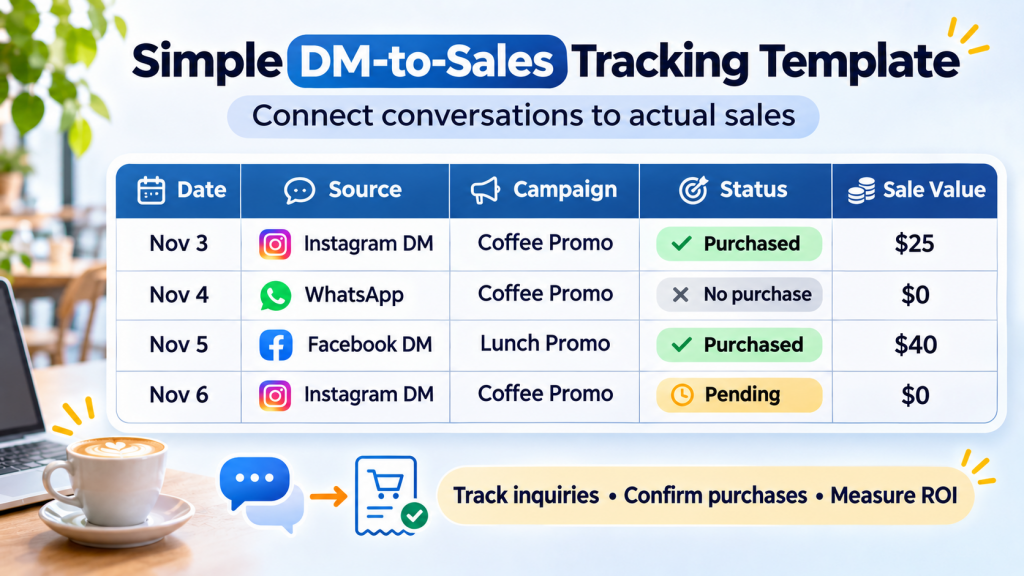
Start by recording a few essential details:
| Date | Source | Campaign | Status | Sale value |
| Nov 3 | Instagram DM | Coffee Promo | Purchased | $25 |
| Nov 4 | Coffee Promo | No purchase | $0 | |
| Nov 5 | Facebook DM | Lunch Promo | Purchased | $40 |
| Nov 6 | Instagram DM | Coffee Promo | Pending | $0 |
This table is a simplified example. For actual tracking, add a unique lead or order ID so that a customer who moves from Instagram DM to WhatsApp isn’t counted twice.
As you collect more information, you can calculate:
- Total inquiries: How many potential customers contacted your business.
- Qualified leads: How many inquiries represented genuine purchase interest.
- Conversion rate: What percentage of inquiries became paying customers.
- Attributed revenue: How much sales revenue can reasonably be connected to each campaign.
- Social media ROI: How much financial return those campaigns generated after considering relevant costs.
For example, suppose your Instagram campaign generates 20 inquiries, of which eight become paying customers.
If each customer spends an average of $50, your tracked revenue is $400.
You can then subtract the variable costs of those sales and compare the remaining contribution with your campaign’s marketing investment, using the social media ROI formula explained earlier.
This gives you a more meaningful financial measurement than simply reporting the number of messages received.
As your business grows, a CRM or integrated sales system can help reduce manual recording and make it easier to follow customer journeys across multiple channels.
6. Review Your Tracking Results Regularly
Collecting data is only useful if you actually review it.
Set aside time each week or month to compare campaigns and identify patterns.
Ask yourself:
- Which posts or promotions generated the most qualified inquiries?
- Which channels produced the highest number of paying customers?
- How many inquiries turned into actual purchases?
- Which campaigns delivered the strongest contribution relative to marketing costs?
- Are customers discovering your business on one platform but completing purchases through another?
You may discover that Instagram generates more inquiries while Facebook attracts customers who spend more per order. Or perhaps your most popular Reel generates fewer purchases than a simple promotional post.
These insights help you make better decisions about your content strategy, advertising budget, and customer follow-up process.
The key to measuring social media ROI isn’t tracking every interaction perfectly. It’s building a consistent process that connects marketing activities with measurable business outcomes.
Start with one campaign, one tracking method, and a few important metrics. Once the process becomes part of your routine, expand it gradually.
With a clearer understanding of where your customers come from and which activities lead to sales, you’ll be better equipped to evaluate the performance of your social media marketing.
The next step is knowing which social media metrics deserve your attention—and which ones can be misleading when evaluating ROI.
Which Social Media Metrics Actually Matter for ROI?
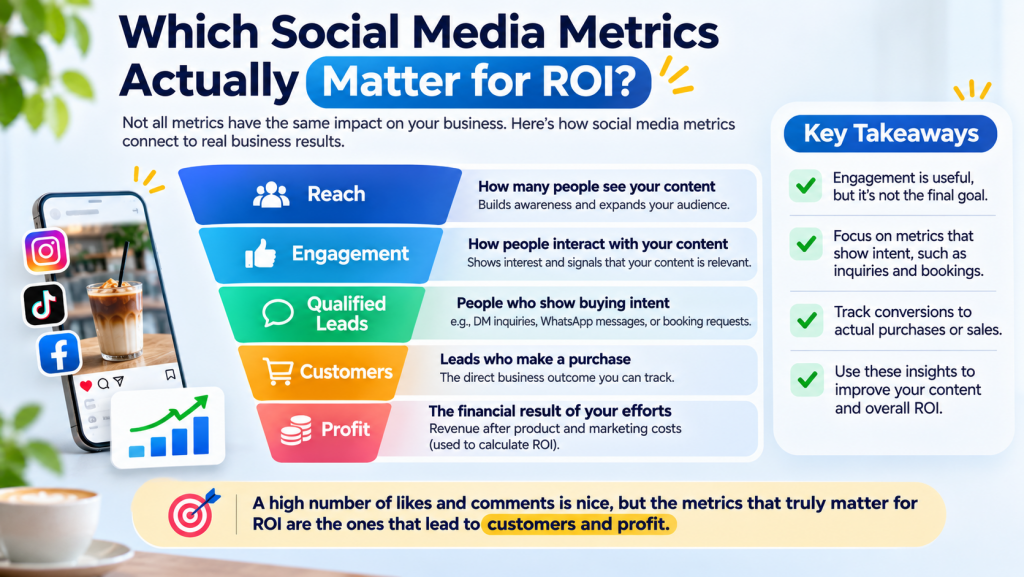
Social media platforms offer dozens of performance metrics, from followers and impressions to engagement rates and video views. But when you’re trying to measure social media ROI, not all metrics carry the same weight.
A post that reaches 50,000 people might generate fewer sales than one seen by just 2,000 potential customers. Similarly, a campaign with hundreds of likes may contribute less revenue than a simple promotional post that encourages people to make a purchase.
The key is understanding which metrics help you evaluate content performance and which ones reveal actual business results.
1. Reach and Impressions: Measuring Brand Visibility
Reach and impressions are among the most common social media metrics.
- Reach measures how many unique accounts see your content.
- Impressions measure how many times your content is displayed, including multiple views by the same account.
These metrics help you understand how widely your content is being distributed.
For example, if your Instagram Reel reaches 10,000 people, that’s a useful indication of brand exposure. However, it doesn’t tell you whether those people are interested in your products or likely to become customers.
Reach becomes more meaningful when you evaluate it alongside audience relevance, inquiries, and conversions.
For a local restaurant, reaching 2,000 people in the surrounding area could be more valuable than reaching 20,000 people who live too far away to visit.
What it tells you: How effectively your content attracts visibility and potential awareness.
What it doesn’t tell you: Whether that visibility generates profitable sales.
2. Engagement Rate: Understanding Audience Interest
Engagement includes interactions such as likes, comments, shares, and saves.
Engagement rate helps you understand how actively people respond to your content relative to its audience or exposure.
A common calculation is:
Engagement Rate (%) = (Total Engagements ÷ Reach) × 100
For example, if a post reaches 2,000 accounts and generates 120 interactions, its engagement rate by reach is 6%.
Keep in mind that analytics platforms may calculate engagement rates differently, sometimes using impressions or followers as the denominator. Use the same calculation method when comparing performance.
While engagement is valuable, it’s important not to confuse it with social media ROI.
A funny video might generate hundreds of comments without attracting a single paying customer. Meanwhile, a product demonstration might receive fewer interactions but encourage several purchase inquiries.
Instead of focusing only on the number of interactions, consider their quality.
Comments asking about prices, availability, or booking details may indicate stronger purchase intent than generic reactions.
What it tells you: How audiences interact with your content and which topics attract their attention.
What it doesn’t tell you: How much financial return your business earns.
3. Link Clicks and Click-Through Rate: Measuring Customer Interest
When your content encourages customers to visit a website, explore a product page, or access a special offer, link clicks become an important metric.
Click-through rate (CTR) measures the percentage of eligible impressions that result in clicks.
CTR (%) = (Link Clicks ÷ Impressions) × 100
Suppose your Facebook campaign generates 150 link clicks from 5,000 impressions.
Your CTR would be 3%.
A higher CTR can indicate that your message and call-to-action are attracting interest. However, it doesn’t automatically mean those visitors will become customers.
For businesses that sell through Instagram DMs or WhatsApp, messaging-link clicks can provide similar information about initial interest.
Just remember that a click on a WhatsApp link doesn’t necessarily mean the customer sent a message or completed a purchase.
What it tells you: Whether your content encourages audiences to take the next step.
What it doesn’t tell you: How many people complete a transaction.
4. Qualified Leads: Identifying Potential Customers
For many small businesses, qualified leads are more valuable than general engagement.
A qualified lead is someone who expresses genuine interest in your product or service and reasonably matches your target customer profile.
For example, a customer who asks about available appointment times and treatment prices at a beauty salon may represent a qualified lead.
Someone who simply likes the salon’s Instagram post is not necessarily a lead.
Tracking qualified leads helps you identify which campaigns attract potential customers rather than just attention.
You can also calculate your cost per qualified lead:
Cost per Qualified Lead = Marketing Campaign Cost ÷ Number of Qualified Leads
If your campaign costs $150 and generates 30 qualified leads, your cost per qualified lead is $5.
This metric is particularly useful for businesses that rely on consultations, bookings, quotations, or direct-message sales.
What it tells you: How efficiently your social media marketing attracts potential buyers.
5. Conversion Rate: Measuring How Many Leads Become Customers
Generating inquiries is important, but turning those inquiries into sales is what drives revenue.
Conversion rate measures the percentage of leads or visitors who complete a desired action.
For a small business that receives orders through Instagram DMs, a useful calculation is:
Lead-to-Customer Conversion Rate (%) = (Paying Customers ÷ Qualified Leads) × 100
For example, imagine your business receives 40 qualified inquiries through Instagram, and 12 of those inquiries result in purchases.
Your conversion rate is:
(12 ÷ 40) × 100 = 30%
This means 30% of your qualified leads became paying customers.
Tracking conversion rate helps you identify whether your marketing is attracting the right audience and whether your sales process is effective.
For example, if your campaign generates plenty of inquiries but few purchases, the issue might not be your content. It could be your pricing, response time, product availability, or customer follow-up process.
Improving those areas may increase your social media ROI without requiring additional advertising expenses.
What it tells you: How effectively your business converts marketing opportunities into customers.
6. Customer Acquisition Cost: Understanding the Cost of Gaining Customers
Customer acquisition cost (CAC) measures how much your business spends to acquire a new customer.
For social media campaigns, you can calculate:
Social Media Customer Acquisition Cost = Campaign Marketing Costs ÷ New Customers Acquired
Suppose your bakery spends $300 on a social media campaign and gains 15 new paying customers.
Your customer acquisition cost is:
$300 ÷ 15 = $20 per new customer
Whether that’s a good result depends on how much contribution profit those customers generate, including potential future purchases.
If your average customer contributes only $12 before marketing costs and never returns, spending $20 to acquire them may be difficult to sustain.
However, if customers frequently return and generate additional profit over time, the same acquisition cost could be more attractive.
This is why CAC should be considered alongside customer value and retention rather than evaluated in isolation.
For accurate reporting, count genuinely new customers where possible, not every order. Include the relevant campaign costs consistently.
7. Attributed Revenue and Contribution Profit: Connecting Marketing to Financial Results
Among all the metrics discussed, attributed revenue and contribution profit bring you closest to understanding your financial social media ROI.
Attributed revenue represents sales that can reasonably be connected to your social media marketing activities.
Contribution profit takes the calculation further by subtracting the variable costs associated with those sales.
For example:
| Metric | Result |
| Attributed sales revenue | $1,500 |
| Product and variable costs | $600 |
| Contribution profit before marketing | $900 |
| Social media marketing costs | $500 |
| Net contribution after marketing | $400 |
| Social Media ROI | 80% |
In this example, the business generates $400 in net contribution after covering its social media marketing investment.
The resulting social media ROI is 80%.
This financial perspective helps business owners compare the economic results of campaigns rather than relying solely on engagement statistics.
Putting the Metrics Together
Instead of treating every metric as equally important, organize your social media reporting around the customer journey.
| Customer journey | Key metrics | Main question |
| Awareness | Reach, impressions | Are people discovering our business? |
| Engagement | Comments, shares, saves, engagement rate | Are audiences interested in our content? |
| Consideration | Link clicks, qualified inquiries | Are potential customers taking action? |
| Conversion | Sales, conversion rate, CAC | Are inquiries turning into customers efficiently? |
| Financial results | Attributed revenue, contribution profit, ROI | Are our marketing efforts generating a positive return? |
For most small businesses, qualified leads, conversion rate, customer acquisition cost, and contribution profit should receive particular attention when evaluating marketing performance.
That doesn’t mean reach and engagement are unimportant. They help explain how your marketing funnel is performing and why some campaigns succeed while others struggle.
The goal is to connect these metrics rather than evaluate them separately.
For example, a campaign with low reach but strong conversion rates may deserve more investment. Meanwhile, a campaign with excellent reach but almost no qualified leads may need better audience targeting or a clearer call-to-action.
By tracking a manageable set of metrics consistently, you can understand what’s working, identify opportunities for improvement, and make more informed marketing decisions.
Ultimately, measuring social media ROI isn’t about collecting more data. It’s about using the right data to understand how your social media activities contribute to business growth.
Social Media ROI Example: A Small Café’s Instagram Campaign
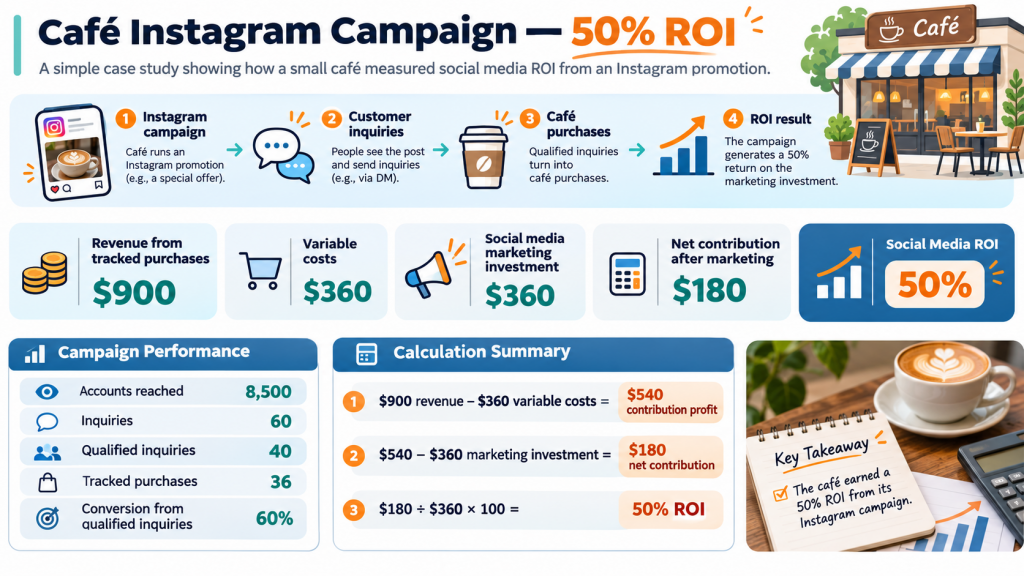
Understanding the formula is one thing. But how does social media ROI work in a real business situation, especially when customers discover your products online but make their purchases through direct messages or in person?
Let’s look at a hypothetical example of a small neighborhood café running an Instagram campaign.
The Campaign: Promoting a Weekend Coffee Special
Imagine a café launching a four-week Instagram campaign to attract more local customers.
The café promotes a weekend coffee-and-pastry special through Instagram Reels, Stories, and a few paid advertisements.
The campaign has three objectives:
- Increase awareness among potential customers living nearby.
- Encourage customers to ask about the promotion through Instagram DMs or WhatsApp.
- Convert those inquiries into actual café visits and purchases.
To track the results, the café creates a unique promotional code, COFFEE10, which customers can mention when ordering or show at the cashier.
The café also uses a campaign-specific WhatsApp message: “Hi, I’d like to know more about the COFFEE10 offer.”
This simple setup allows the café to identify some of the customers who discover its promotion through Instagram, even when they make their purchases offline.
Step 1: Review the Instagram Campaign Performance
After four weeks, the café reviews its Instagram analytics and customer inquiries.
| Campaign metric | Result |
| Instagram accounts reached | 8,500 |
| Post and Reel engagements | 680 |
| Instagram DM and WhatsApp inquiries | 60 |
| Qualified inquiries | 40 |
| Purchases from qualified inquiries | 24 |
| Additional in-store purchases using the promo code | 12 |
| Total tracked purchases | 36 |
The café discovers that 24 of its 40 qualified inquiries resulted in completed purchases.
Lead-to-Customer Conversion Rate = (24 ÷ 40) × 100 = 60%
That means 60% of qualified customers who contacted the café eventually made a purchase.
Additionally, 12 customers visited the café and redeemed the Instagram promotional code without having a previously recorded inquiry.
The café checks its sales records to ensure those 12 purchases aren’t duplicates of the 24 purchases already counted.
As a result, the campaign has 36 tracked purchases.
However, this doesn’t necessarily represent every customer influenced by Instagram. Some visitors may have seen the promotion but purchased without mentioning the code.
Step 2: Calculate the Revenue Generated
Suppose the 36 tracked purchases have an average transaction value of $25, after any promotional discounts.
The café calculates:
36 purchases × $25 = $900 in attributed revenue
Next, the café estimates that ingredients, packaging, and other variable costs represent 40% of those sales.
Variable Costs = $900 × 40% = $360
That leaves:
Contribution Profit = $900 − $360 = $540
The campaign generated $540 in contribution profit before accounting for the café’s social media marketing expenses.
Step 3: Calculate the Social Media Marketing Investment
The café also records how much it spent promoting the campaign.
| Marketing expense | Cost |
| Instagram advertising | $180 |
| Photography and content creation | $120 |
| Allocated social media tools and staff time | $60 |
| Total marketing investment | $360 |
Although the café spent only $180 on advertising, its complete marketing investment was $360 after including content creation, tools, and staff time.
This distinction matters because calculating social media ROI using advertising expenses alone would make the campaign appear more profitable than it actually was.
Step 4: Calculate the Social Media ROI
Now the café has the information needed to calculate its return.
- Attributed revenue: $900
- Product and variable costs: $360
- Contribution profit before marketing: $540
- Social media marketing investment: $360
First, subtract the marketing investment from the contribution profit.
$540 − $360 = $180
The café generated $180 in net contribution after covering its campaign costs.
Next, calculate social media ROI:
Social Media ROI = ($180 ÷ $360) × 100 = 50%
The café achieved a 50% social media ROI.
In simple terms, for every $1 spent on social media marketing, the café recovered its marketing investment and generated an additional $0.50 in contribution after accounting for the variable costs of the tracked sales.
Here’s the complete financial picture:
| Financial metric | Amount |
| Revenue from tracked purchases | $900 |
| Food, packaging, and variable costs | −$360 |
| Contribution profit before marketing | $540 |
| Social media marketing investment | −$360 |
| Net contribution after marketing | $180 |
| Social Media ROI | 50% |
This example uses hypothetical figures and simplified cost assumptions. The calculation measures the return from sales attributed to the campaign, not necessarily the additional sales caused by the campaign.
Step 5: What Can the Café Learn from These Results?
The campaign produced a positive return, but the numbers tell a more useful story when the café looks beyond the final ROI percentage.
First, Instagram generated meaningful customer interest.
The café received 60 inquiries, including 40 qualified leads. This suggests that its content attracted people who were genuinely interested in the offer.
Second, the conversion process worked reasonably well.
Of the 40 qualified inquiries, 24 resulted in purchases. The café could review what helped those customers decide to buy, such as quick responses, clear pricing, or convenient ordering.
Third, offline tracking revealed additional sales.
Without the COFFEE10 promotional code, the café might have overlooked the 12 in-store purchases made by customers who never contacted the business through DMs.
Fourth, revenue alone didn’t show the true financial return.
Although the campaign generated $900 in tracked sales, its net contribution after product and marketing costs was only $180.
That difference is why calculating social media ROI using contribution profit provides a more realistic understanding of campaign performance.
What Should the Café Do Next?
Based on these results, the café could make several practical improvements.
For its next campaign, it could test different Instagram Reels and Stories to see which content attracts more qualified inquiries. It could also improve its WhatsApp response process, making it easier for customers to ask questions and confirm orders.
The café might experiment with a higher-margin promotional bundle or encourage customers to make repeat purchases.
Most importantly, it should continue recording campaign-related sales and costs using the same measurement approach.
One important consideration is that a purchase using a promotional code isn’t necessarily an entirely new sale. Some customers may have visited the café even without seeing the Instagram campaign.
To better understand the campaign’s incremental impact, the café could compare results with similar periods without the promotion, while accounting for factors such as holidays, weather, and normal changes in customer traffic.
The lesson: You don’t need a complicated analytics system to start measuring social media ROI. Even a small café can gain useful insights by combining social media analytics, customer inquiries, promotional codes, and basic sales records.
The goal isn’t just to prove that social media generates sales. It’s to identify which marketing activities produce meaningful returns and use that information to make better business decisions.
How to Improve Social Media ROI Without Increasing Your Budget
Improving social media ROI doesn’t always mean spending more money on advertising or creating more content. Sometimes, the biggest improvements come from making better use of the resources you already have.
For small businesses with limited marketing budgets, the goal should be to generate more meaningful results from existing campaigns, content, and customer interactions.
This could mean focusing on posts that attract potential buyers, improving how quickly your team responds to inquiries, or reducing the time spent creating content that delivers little value.
Here are five practical ways to improve your social media ROI without increasing your
1. Focus on Content That Generates Qualified Leads
Not all social media content needs to generate immediate sales. Educational posts, entertaining videos, and behind-the-scenes content can build awareness and trust.
However, if your objective is to improve social media ROI, you also need content that encourages potential customers to take action.
Start by reviewing your previous posts and identifying which ones generated meaningful inquiries, website visits, bookings, or purchases.
For example, imagine a beauty salon that regularly posts hairstyle inspiration and treatment videos.
The salon discovers that its hairstyle inspiration posts receive more likes, but short videos explaining treatment benefits and prices generate more appointment inquiries.
Instead of abandoning inspirational content, the salon could adjust its content mix to include more educational and conversion-focused posts.
Consider adding clearer calls-to-action, such as:
- “DM us to check available appointments.”
- “Send us a WhatsApp message for today’s menu.”
- “Book your consultation through the link in our bio.”
- “Mention this promotion when visiting our store.”
The important thing is to make the next step easy for potential customers.
Practical tip: Review your five posts with the most qualified inquiries, not just the highest engagement. Identify what they have in common, such as content format, topic, offer, or call-to-action, and use those insights to improve future posts.
2. Repurpose Your Best-Performing Content
Creating new content from scratch can be time-consuming and expensive.
Instead of constantly searching for new ideas, look for opportunities to reuse and adapt content that has already performed well.
For example, a small restaurant might create an Instagram Reel showing how its signature dish is prepared.
That single video could become:
- A shorter version for TikTok or YouTube Shorts.
- An Instagram Story highlighting the dish of the week.
- A photo carousel explaining the ingredients.
- A Facebook post featuring customer feedback.
- A promotional post encouraging customers to make a reservation.
Each version can serve a different purpose while using much of the same original material.
This approach reduces production time and helps your best ideas reach audiences across multiple platforms.
However, content repurposing should involve more than copying the same post everywhere. Adjust the format, caption, and call-to-action to match each platform and audience.
A well-organized content calendar can make this process easier. If you’re looking for a structured approach, explore our guide on [5 Content Planning Tips to Simplify Social Media Management](https://sociosight.co/content-planning-tips-social-media-management/).
By reducing unnecessary content production expenses, your business can potentially improve social media ROI even if revenue remains unchanged.
3. Improve Your DM-to-Sale Conversion Process
For businesses that sell through Instagram DMs, Facebook Messenger, or WhatsApp, improving the customer conversation process can have a direct impact on sales.
Think about what happens when a potential customer sends a message asking about your product.
Do they receive a clear response? Can they easily find the price? Does your team explain how to order or book? Are interested customers followed up when appropriate?
Sometimes, a business doesn’t need more inquiries. It needs to convert more of the inquiries it already receives.
Consider this hypothetical example:
A small online shop receives 50 qualified inquiries from an Instagram campaign.
Initially, 10 customers complete a purchase, resulting in a 20% conversion rate.
After improving its response process, the shop converts 15 of the same number of qualified inquiries into purchases.
Its conversion rate increases to 30%.
If each additional purchase generates $20 in contribution profit before marketing expenses, those five extra purchases add $100 in contribution without increasing the advertising budget.
That’s a meaningful improvement in social media ROI.
To improve your conversion process, consider preparing clear product information, organizing common customer questions, and creating a simple follow-up procedure for interested buyers.
Follow-ups should be helpful rather than intrusive, and businesses should respect customers’ communication preferences and applicable messaging rules.
For more ideas, read our article on Email Marketing and Social Media: The Follow-Up System Every Business Owner Needs, which explains how structured follow-up can support customer relationships and repeat purchases.
4. Compare Campaign Performance and Reallocate Your Budget
If you’re running multiple social media campaigns, they probably aren’t all generating the same financial return.
One Instagram campaign might attract plenty of attention but few paying customers, while another produces fewer inquiries but a higher conversion rate.
Instead of distributing your advertising budget equally, compare the financial performance of each campaign.
For example:
| Campaign | Marketing cost | Contribution before marketing | Net contribution | ROI |
| Campaign A | $200 | $260 | $60 | 30% |
| Campaign B | $200 | $400 | $200 | 100% |
| Campaign C | $200 | $160 | -$4- | -20% |
Hypothetical results, using the same contribution-based ROI calculation described earlier.*
In this example, Campaign B delivers the strongest measured social media ROI.
The business could investigate whether Campaign B’s offer, audience, creative format, or messaging contributed to its better performance.
It might then shift part of Campaign C’s budget toward testing similar approaches.
However, avoid assuming that doubling the budget of a successful campaign will automatically double its return. Campaign results can change as you reach different audiences, increase ad frequency, or encounter higher advertising costs.
A better approach is to make gradual adjustments, monitor performance, and compare results over a reasonable period.
Also, consider whether campaigns serve different purposes. An awareness campaign may support future sales without producing immediate conversions, so it shouldn’t always be judged by the same short-term expectations as a sales campaign.
5. Automate Content Scheduling and Reporting Where Useful
Time is another important part of your social media marketing investment.
If you spend several hours every week manually publishing posts, switching between accounts, and collecting performance data, those activities carry a cost—even if you’re doing the work yourself.
Using a social media management tool can help reduce repetitive tasks and make your workflow more efficient.
For example, instead of publishing posts individually throughout the week, you could prepare your content in advance and schedule it from a centralized dashboard.
You can also organize content ideas, review performance data, and use those insights to guide future decisions.
AI-assisted content creation can further reduce the time spent brainstorming ideas or preparing initial captions, provided the results are reviewed for accuracy and brand consistency.
For a practical example, see How to Use Sociosight’s AI Content Writing Wizard, which explains how content ideas can be developed using topics, images, and previous Instagram posts.
Automation doesn’t directly guarantee higher sales. Its financial value comes from reducing unnecessary work, supporting consistent execution, and freeing up time for activities such as customer engagement and campaign improvement.
When evaluating whether a tool improves social media ROI, compare the time and resources saved with its subscription cost.
Small Improvements Can Make a Meaningful Difference
Improving social media ROI is rarely about finding one perfect post or campaign.
More often, it comes from making several small improvements across your marketing process.
Consider a business that maintains the same monthly marketing budget but manages to:
- Reduce content production time by repurposing existing materials.
- Generate more qualified inquiries through clearer calls-to-action.
- Convert more conversations into completed purchases.
- Shift advertising spending toward better-performing campaigns.
- Spend less time on repetitive scheduling and reporting tasks.
Each improvement can contribute to better financial performance without requiring a larger budget.
The important thing is to measure what changes and determine whether those changes genuinely improve results.
Better social media ROI comes from making your existing marketing efforts work more efficiently, not simply posting more often or spending more money.
And while these improvements can begin with spreadsheets and manual tracking, the right social media management tools can make content planning, performance monitoring, and ongoing optimization easier to manage as your business grows.
How Social Media Management Tools Support Better ROI Tracking
Measuring social media ROI becomes easier when you have a clear view of your content performance and marketing activities. While spreadsheets can help you track sales and conversions, social media management tools can simplify the process of monitoring and improving your campaigns.
Instead of switching between multiple platforms, you can use a centralized dashboard to manage your content and evaluate its performance.
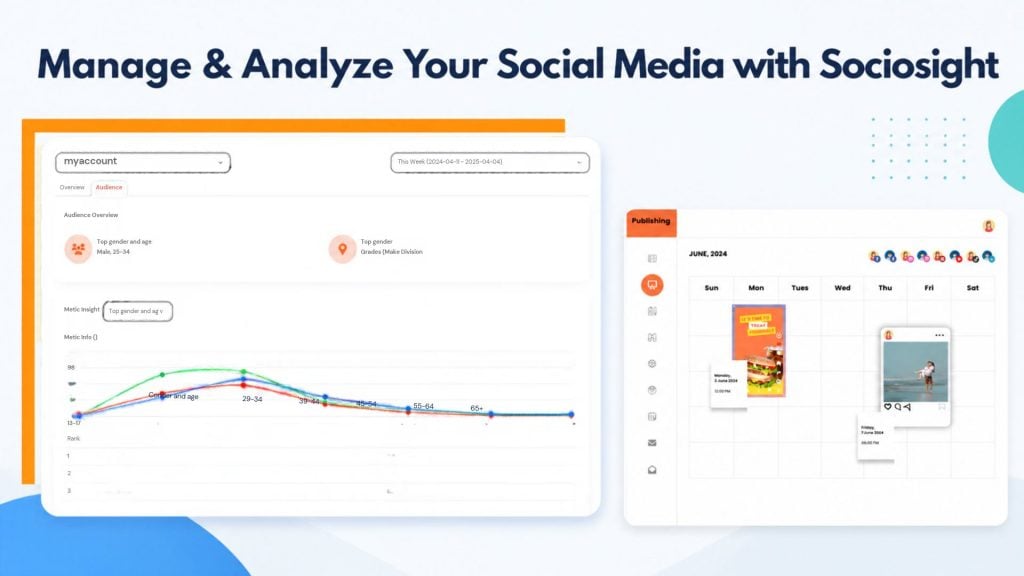
Here are three ways these tools can help:
- Content scheduling: Plan and publish posts consistently while reducing the time spent on manual tasks.
- Performance analytics: Identify which posts generate the most reach, engagement, and audience interest.
- Content optimization: Use past performance insights to improve future content and focus on strategies that deliver better results.
For example, Sociosight helps businesses manage social media scheduling, monitor content performance, and generate content ideas with AI assistance.
If you’re managing Instagram as part of your marketing strategy, our article on social media management tools for Instagram explains how these features can simplify daily marketing activities.
However, remember that social media analytics alone cannot calculate your complete financial ROI. You still need to connect campaign performance with actual sales, customer acquisition costs, and business expenses.
The real value of social media management tools is helping you work more efficiently and make better marketing decisions. When combined with reliable sales tracking, they can support a clearer understanding of your social media ROI.
Ready to simplify your social media workflow? Explore Sociosight and get started for free.
Frequently Asked Questions About Social Media ROI
What Is a Good Social Media ROI?
A good social media ROI means your marketing activities generate more financial value than they cost. However, there’s no universal benchmark that applies to every business.
A 50% ROI may be attractive for one business but insufficient for another, depending on profit margins, customer acquisition costs, and long-term customer value.
Instead of relying on a fixed industry benchmark, compare your ROI across campaigns and track whether your results improve over time.
How Do You Calculate Social Media ROI Without a Website?
You can measure social media ROI even if your business doesn’t have a website.
Track customer inquiries through Instagram DMs, Facebook Messenger, or WhatsApp, and record which conversations lead to purchases. You can also use promotional codes or ask customers how they discovered your business.
Once you know your attributed sales revenue, variable costs, and marketing investment, you can calculate your social media ROI using the formula discussed earlier.
Can You Measure Instagram ROI Without Running Ads?
Yes. Organic Instagram marketing still requires an investment of time and resources.
You can calculate Instagram ROI by estimating the costs of content creation, account management, and social media tools, then comparing those expenses with the contribution profit generated from tracked Instagram-related sales.
Even without paid advertising, measuring your results helps you understand whether your organic marketing efforts are worthwhile.
How Often Should Small Businesses Measure Social Media ROI?
For most small businesses, reviewing campaign performance weekly and calculating social media ROI monthly is a practical starting point.
Weekly reviews help identify changes in engagement, inquiries, and conversions. Monthly reviews provide a broader picture of financial performance.
For businesses with longer sales cycles, quarterly evaluations may provide more meaningful insights.
What Is the Difference Between Social Media ROI and ROAS?
Social media ROI and Return on Ad Spend (ROAS) measure different aspects of marketing performance.
ROAS compares advertising revenue with advertising expenditure.
For example, if you spend $200 on Instagram Ads and generate $800 in attributed sales, your ROAS is 4:1, or 400%.
Social media ROI goes further by considering the financial contribution from sales and the broader costs of your marketing activities, including content production, tools, and labor.
ROAS helps evaluate advertising efficiency, while social media ROI provides a more complete picture of marketing profitability.
Conclusion: Start Measuring Business Results, Not Just Engagement
Measuring social media ROI isn’t about proving that every like, comment, or follower generates revenue. It’s about understanding how your social media activities contribute to real business results.
Even when customers purchase through Instagram DMs, WhatsApp, or physical stores, you can begin connecting marketing efforts with sales using simple tracking methods, promotional codes, and customer records.
Start small. Choose a campaign, track your marketing costs and conversions, and calculate the financial return. Use what you learn to improve your content, customer engagement, and marketing decisions.
Remember, a successful social media strategy isn’t necessarily the one that generates the most engagement. It’s the one that helps your business achieve its goals efficiently.
With Sociosight, you can simplify content planning, schedule posts, and monitor social media performance from one platform, giving you more time to focus on growing your business.