



Random Posting Is Not a Strategy
Social media is no longer something you can treat as a side task.
According to Content Marketing Institute, 89% of B2B marketers use organic social media platforms to distribute content. HubSpot also reports that nearly 59% of social media teams say increasing brand awareness is their top goal.
But if social media is already that important, why does your social media post still feel so rushed?
Why are you still deciding what to post only a few hours before publishing?
Why are captions written at the last minute?
Why are campaign ideas scattered across chats, documents, spreadsheets, and someone’s memory?
Why do you post consistently for two weeks, then suddenly disappear?
Why does your social media still feel chaotic when you already know your business needs to show up online?
The answer is often simple: you do not have a clear content calendar.
A content calendar helps you turn random posting into intentional publishing. It gives you a clear plan for what to post, when to post, where to publish, and why each post matters. Instead of treating every post as a separate task, a content calendar helps you connect your content to bigger goals such as awareness, engagement, leads, sales, and customer retention.
Do you struggle with managing multiple social media platforms for your brand's presence?
The Sociosight app can help you simplify the process and save you time. With Sociosight, you can publish, schedule, and monitor posts and engage with your followers across multiple social media platforms, all from one dashboard.
Get started today with a free sign-up!
Register Now for Free

But having a content calendar is not enough.
You can still make mistakes with your content calendar. You may fill it with random ideas, forget to check analytics, ignore platform differences, or create a plan that nobody on your team actually follows.
In this article, we will look at nine common content calendar mistakes that keep you posting randomly, and how to avoid them so your social media becomes more organized, consistent, and easier to manage.
9 Common Content Calendar Mistakes
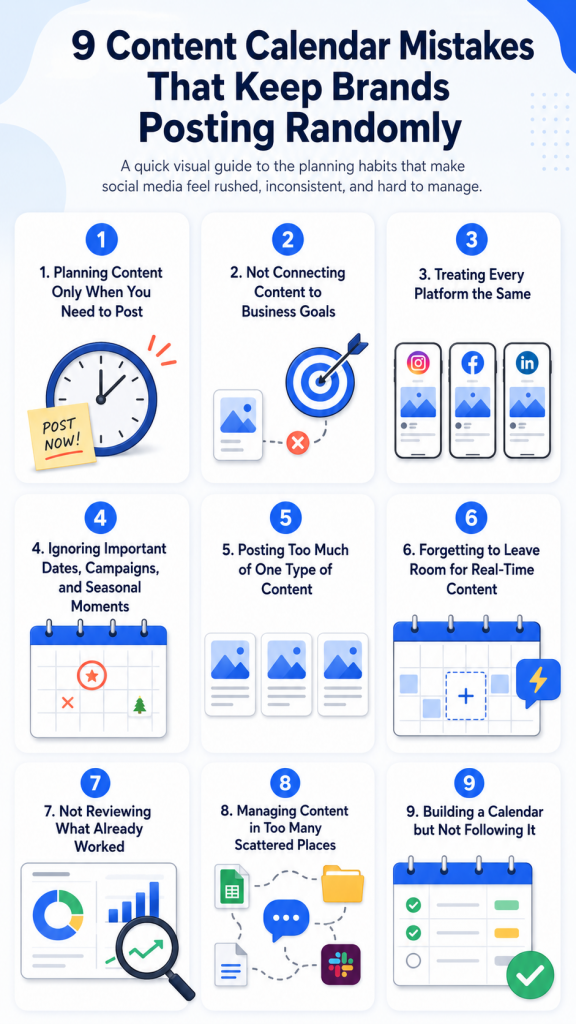
Table of Contents
1. Planning Content Only When You Need to Post
One of the biggest content calendar mistakes is planning your content only when it is time to publish.
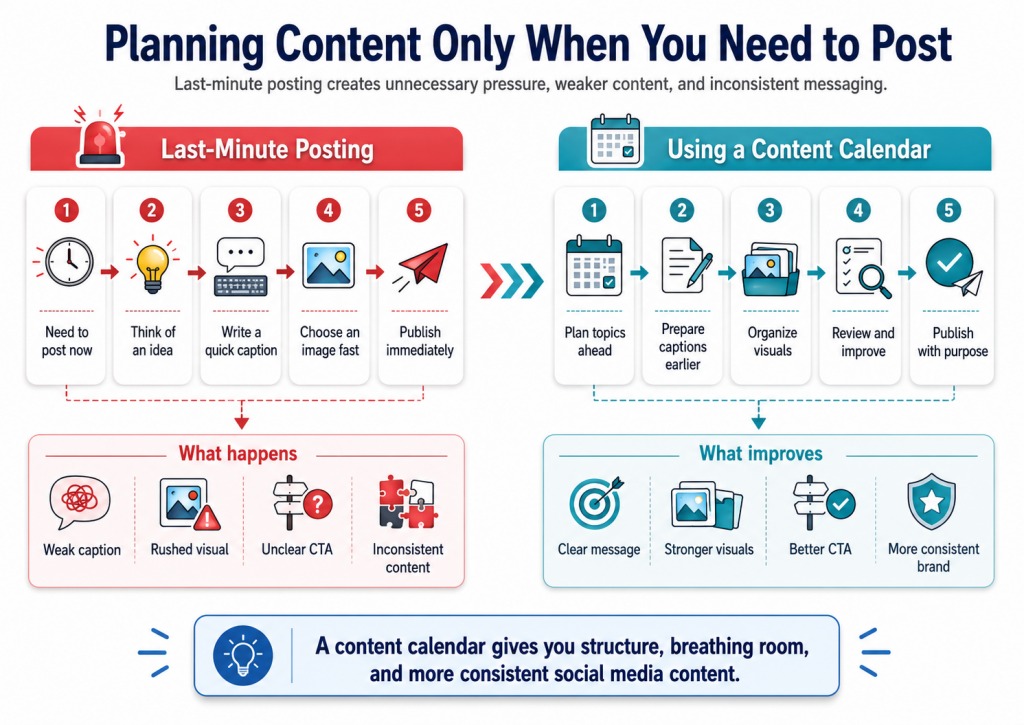
At first, this may not look like a serious problem. You open your laptop, think of an idea, write a quick caption, choose an image, and post it. It feels simple enough.
But over time, this habit makes your social media profiles harder to manage.
When you only plan content at the last minute, you put yourself under unnecessary pressure. Instead of creating content with a clear message, you are forced to create whatever feels possible in the moment.
Your caption becomes weaker because you do not have enough time to shape the idea. Your visual becomes rushed because you are trying to finish it quickly. Your call to action becomes unclear because you are focused on getting the post out, not on what you want the post to achieve.
This is how random posting starts.
You may still be posting, but your content does not feel connected. One day, you talk about your product. The next day, you share a trend. Then you post a quote, a promotion, or a behind-the-scenes photo without a clear direction. Each post may look fine on its own, but together, your social media starts to feel inconsistent.
A content calendar helps you avoid this pattern.
With a content calendar, you are not deciding everything at the last minute. You can plan your topics ahead of time, prepare captions earlier, organize visuals before the deadline, and make sure each post supports your bigger marketing goals.
A good content calendar also gives you more breathing room. You can review your ideas before publishing. You can improve weak captions. You can adjust visuals. You can check whether your message is still aligned with your brand voice.
The goal is not to remove flexibility from your content. You can still respond to trends, current events, or audience feedback. But your content calendar gives you a foundation, so your entire social media strategy does not depend on daily improvisation.
If you only create content when you need to post, your content will always feel urgent. But when you use a content calendar, you can start posting with more clarity, consistency, and purpose.
2. Not Connecting Content to Business Goals
Another common content calendar mistake is posting just to “stay active.”
You may feel like you are doing the right thing because your account is not silent. You publish a quote today, a product photo tomorrow, a quick tip next week, and maybe a promotional post when you remember. On the surface, your social media looks alive.
But being active is not the same as being strategic.
If your content is not connected to a clear business goal, your content calendar can quickly become a list of random posts. You may be publishing regularly, but you are not guiding your audience toward anything meaningful.
Before you add another post to your content calendar, ask yourself: what is this post supposed to do?
Is it meant to increase brand awareness?
Is it meant to educate your audience?
Is it meant to build trust?
Is it meant to collect leads?
Is it meant to drive sales?
Is it meant to strengthen your community?
Is it meant to retain existing customers?
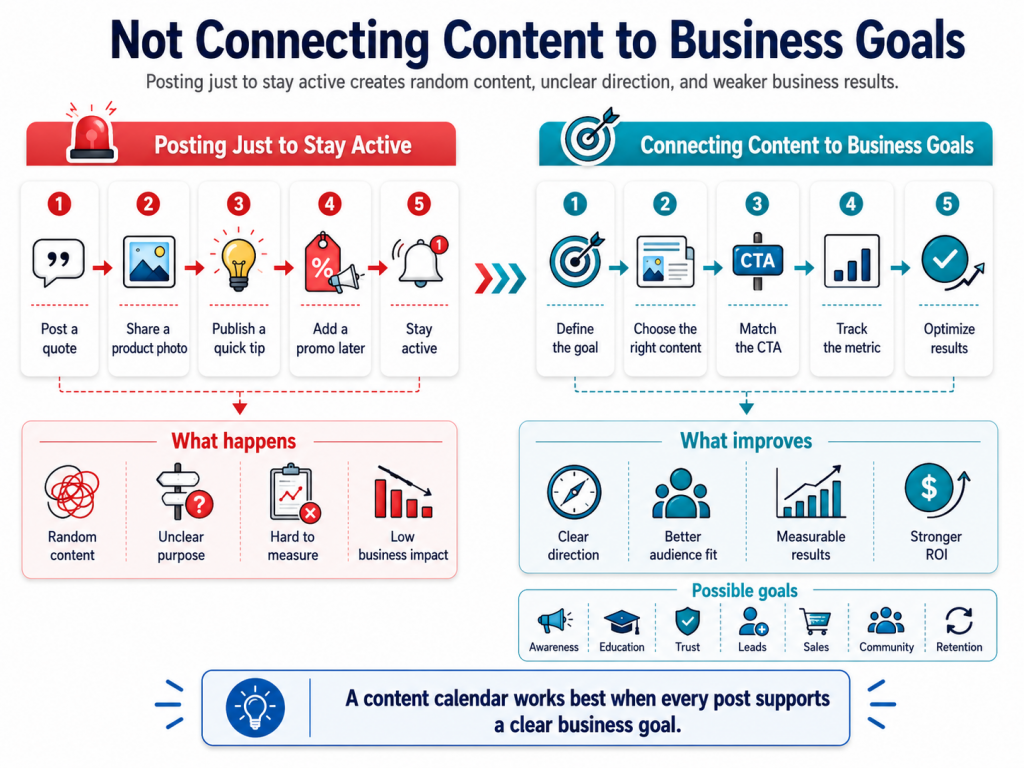
When you do not define the goal, your content becomes harder to measure. A post may get likes, but does it help people understand your brand better? A video may get views, but does it attract the right audience? A promotional post may reach people, but does it move them closer to buying?
A strong content calendar should not only tell you when to post. It should help you understand why you are posting.
For example, if your goal is awareness, your content calendar may include educational posts, short videos, industry insights, or relatable content that introduces your brand to new people. If your goal is lead generation, you may plan posts that promote free resources, webinars, consultations, or newsletter sign-ups. If your goal is sales, your content calendar should include product benefits, testimonials, offers, comparisons, and clear calls to action.
This is where your content calendar becomes more than a schedule. It becomes a marketing roadmap.
When every post has a purpose, your social media starts to feel more connected. Your audience can understand what you offer, why it matters, and what they should do next. Your team also gets a clearer direction because they are not just creating content to fill empty dates.
So, instead of asking, “What should we post today?” start asking, “What goal should this content support?”
That small shift can make your content calendar more focused, more measurable, and more useful for your business.
3. Treating Every Platform the Same
A content calendar mistake that quietly weakens your social media performance is treating every platform the same.
It may feel efficient to create one post, copy the same caption, use the same visual, and publish it everywhere. After all, it saves time. You already have the content, so why not use it on Instagram, Facebook, LinkedIn, TikTok, and Pinterest?
The problem is that your audience does not use every platform in the same way.
What works on Instagram may feel too casual for LinkedIn. What works on TikTok may not fit Pinterest. What gets attention on Facebook may not stop someone from scrolling on Instagram Reels. When you force the same content into every platform, you may save time in the short term, but you often reduce the impact of your message.
Each platform has its own behavior, format, tone, and timing.
On Instagram, your visual presentation matters a lot. You may need strong images, short videos, carousel posts, Reels, Stories, and captions that encourage saves, shares, comments, or profile visits.
On Facebook, your content may need to feel more conversational and community-focused. It can work well for updates, stories, links, events, groups, and audience discussions.
On LinkedIn, your content should usually sound more professional and insight-driven. A post that feels too promotional or too casual may not perform well if your audience expects useful ideas, business lessons, opinions, or industry perspective.
On TikTok, the opening seconds matter. You need content that feels native to short-form video, with a clear hook, natural delivery, and a reason for people to keep watching.
On Pinterest, your content needs to be searchable and visually useful. People often come to Pinterest for inspiration, ideas, and future social media planning, so your content should be designed with discovery in mind.
This does not mean you need to create completely different content for every platform. You can still repurpose one idea. But your content calendar should help you adapt that idea for each channel.
For example, one educational topic can become an Instagram carousel, a LinkedIn text post, a TikTok short video, a Facebook discussion post, and a Pinterest graphic. The core message stays the same, but the format, caption, call to action, and publishing time are adjusted for each platform.
That is how a content calendar helps you work smarter.
Instead of copying and pasting the same post everywhere, your content calendar can show how one idea should appear across different channels. You can plan platform-specific captions, visuals, formats, hashtags, and posting times before the content goes live.
When you treat every platform the same, your content often feels generic. But when your content calendar helps you adapt content for each platform, your message becomes more relevant, more natural, and more likely to perform well.
4. Ignoring Important Dates, Campaigns, and Seasonal Moments
Another content calendar mistake is planning your posts without looking at what is coming next.
You may create content week by week, publish whatever is ready, and focus only on your usual posting routine. But when you do not plan around important dates, campaigns, and seasonal moments, you can miss valuable opportunities to connect with your audience at the right time.
Your audience does not experience your content in isolation. They are also paying attention to holidays, events, trends, promotions, product launches, industry updates, and cultural moments. If your content calendar does not consider these moments, your social media can feel disconnected from what people are already thinking about.
For example, you may forget to prepare content for a product launch until a few days before it happens. You may miss a holiday campaign because you did not plan the visuals early enough. You may ignore an industry awareness day that could have helped you educate your audience. You may run a promotion but fail to build anticipation before it starts.
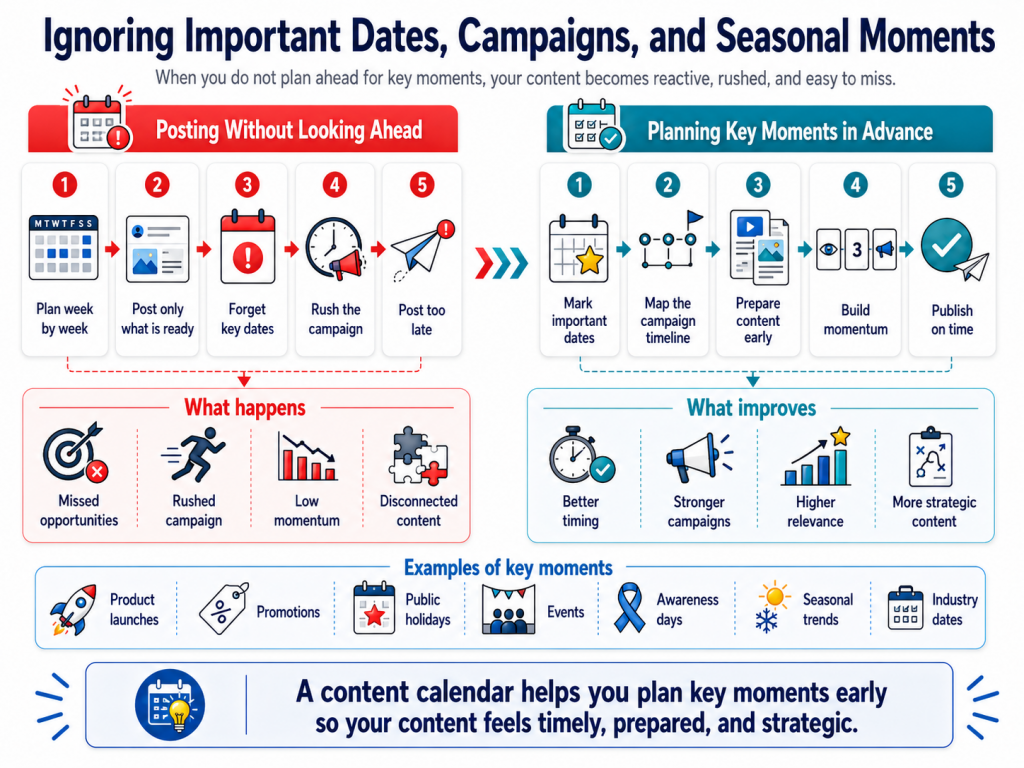
This is how opportunities slip away.
A content calendar helps you see the bigger picture before the deadline arrives. Instead of suddenly realizing that an important date is next week, you can prepare your social media campaign in advance. You can plan teaser posts, educational content, promotional content, reminder posts, and follow-up content that support the same goal.
This matters because strong campaigns are rarely built from one post.
A launch may need several posts before, during, and after the launch date. A seasonal promotion may need awareness content, offer explanation, testimonials, countdown reminders, and final call posts. An event may need announcement posts, speaker highlights, registration reminders, live updates, and recap content.
Without a content calendar, you may only post when the moment has already arrived. With a content calendar, you can build momentum before the moment happens.
Your content calendar should include more than daily post ideas. It should also include product launches, sales campaigns, company events, public holidays, industry dates, awareness days, seasonal trends, and audience-relevant moments. This gives your content more context and helps you avoid rushed, last-minute campaigns.
Of course, not every trend or holiday deserves a post. Your content calendar should help you choose the moments that actually fit your brand, audience, and business goals. The point is not to join every conversation. The point is to avoid missing the right ones.
When you ignore important dates, your content becomes reactive. But when your content calendar includes campaigns and seasonal moments, your social media becomes more prepared, timely, and strategic.
5. Posting Too Much of One Type of Content
A content calendar can still feel random when it is filled with too much of the same type of content.
You may think consistency means posting the same kind of content again and again. So you keep publishing promotional posts. Or you keep sharing educational tips. Or you rely heavily on memes, testimonials, product photos, behind-the-scenes updates, or customer stories.
The problem is not that these content types are wrong.
The problem is depending on only one of them.
If your content calendar is filled with too many promotional posts, your audience may feel like you are always trying to sell something. If your content calendar is only educational, people may learn from you but never feel invited to take action. If you post too many memes, your brand may get attention but lose clarity. If you only share testimonials, your content may start to feel repetitive. If you only post product content, your audience may understand what you sell but not why they should care.
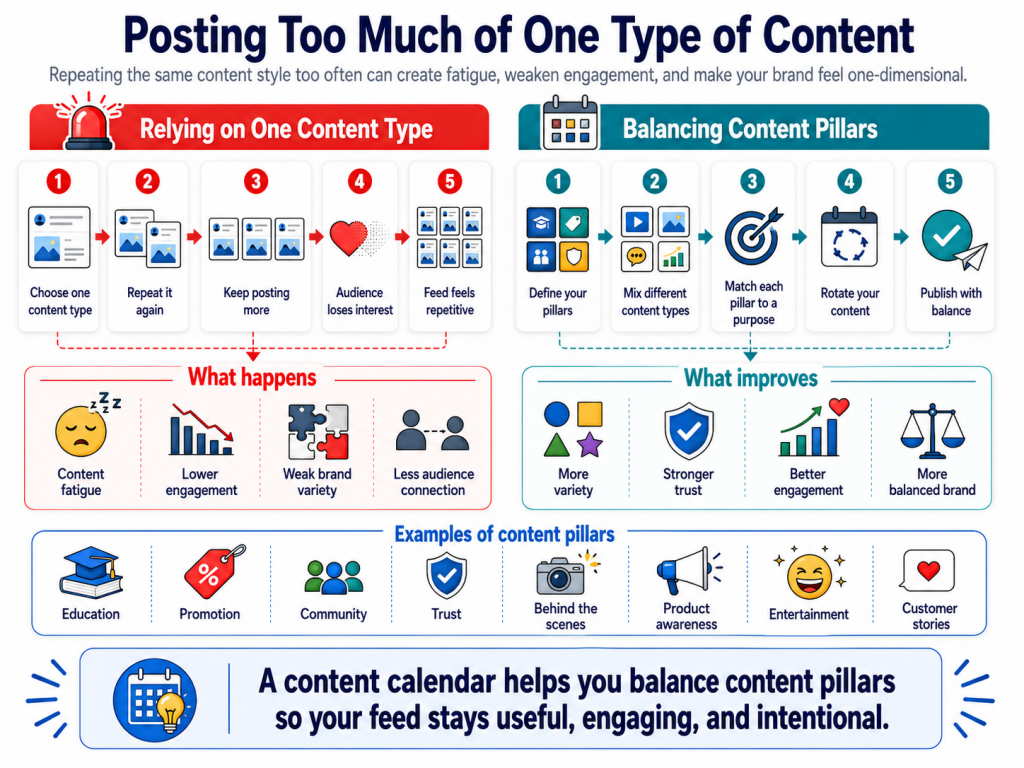
A strong content calendar should help you create balance.
This is where content pillars become important. Content pillars are the main categories of content your brand regularly talks about. They help you avoid posting randomly while making sure your content supports different audience needs and business goals.
For example, your content calendar may include content pillars such as education, promotion, community, trust-building, entertainment, behind-the-scenes content, customer stories, and product awareness. Each pillar has a different role.
Educational content helps your audience understand a problem.
Promotional content encourages people to take action.
Community content helps people feel connected to your brand.
Testimonials build trust.
Product content explains what you offer.
Behind-the-scenes content makes your brand feel more human.
Entertainment content can increase relatability and engagement.
When your content calendar includes different content pillars, your social media becomes more complete. You are not only selling. You are not only teaching. You are not only entertaining. You are building a more balanced relationship with your audience.
This balance also helps you avoid content fatigue. If people see the same message too often, they may stop paying attention. But when your content calendar rotates between different content pillars, your feed feels more interesting, useful, and intentional.
A simple way to check your content calendar is to look at your upcoming posts and ask: are we repeating the same type of content too much?
If the answer is yes, you may need to adjust your content mix.
Your content calendar should not only help you publish more consistently. It should help you publish with variety, purpose, and direction. When your content pillars are balanced, your social media can educate, build trust, create engagement, and support business growth without feeling repetitive.
6. Forgetting to Leave Room for Real-Time Content
A content calendar should help you stay organized, not make your brand rigid.
One mistake you can make is planning your content calendar so tightly that there is no space for anything spontaneous. Every slot is already filled. Every caption is already prepared. Every topic is already decided. At first, this may feel efficient, but it can make your social media feel too fixed and disconnected from what is happening around your audience.
Social media moves quickly.
Trends appear suddenly. Industry news can change the conversation. Your audience may ask questions you did not expect. A customer comment may inspire a useful post. A current event may create a new opportunity to share your perspective. If your content calendar has no room for real-time content, you may miss moments that could make your brand feel relevant, responsive, and alive.
This does not mean you should abandon your content calendar every time something new happens.
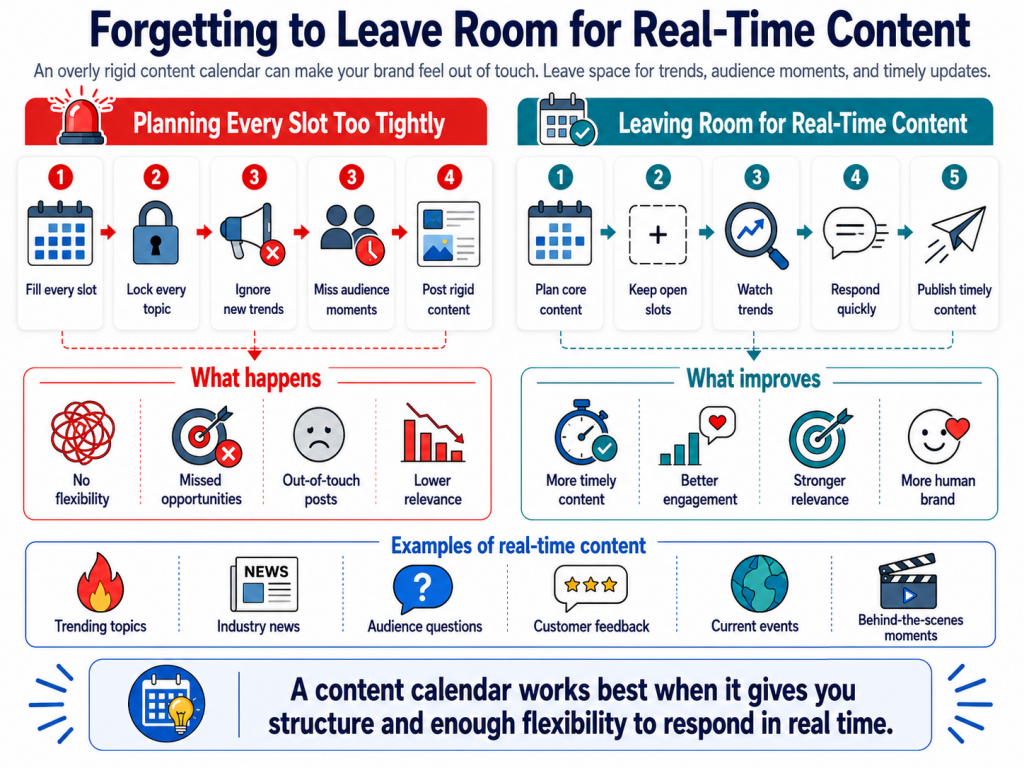
The goal is balance.
Your content calendar should give you a clear plan, but it should also leave room for flexibility. You can plan your core content in advance while keeping a few open slots for trends, news, audience reactions, or spontaneous updates. This way, you are not forced to choose between being organized and being timely.
For example, you may schedule your educational posts, promotional campaigns, and product content ahead of time. But you can still leave space each week for a trending topic, a quick response to a customer question, a behind-the-scenes moment, or an industry update that your audience needs to know.
This makes your content calendar more realistic.
Real social media management is not only about following a schedule. It is also about listening. You need to notice what your audience is talking about, what questions they are asking, what problems they are facing, and what conversations are happening in your industry.
A flexible content calendar helps you respond without losing direction. You still have your planned content, but you are not trapped by it. You can move posts around, adjust captions, add timely content, or pause something that no longer feels appropriate.
This is especially important when your audience expects your brand to be aware of what is happening. If you keep publishing scheduled content without considering the current context, your posts may feel out of touch.
A strong content calendar gives you structure, but it should never remove your ability to respond.
When you leave room for real-time content, your social media becomes more human. You are not just broadcasting planned messages. You are joining the conversation at the right moment, with content that feels timely, useful, and relevant.
7. Not Reviewing What Already Worked
Another content calendar mistake is always creating new content without reviewing what already worked.
It is easy to get trapped in the cycle of producing more. You need another post, another caption, another video idea, another campaign, and another design. But if you never look back at your past performance, your content calendar becomes based on guessing instead of learning.
Your previous content already contains useful signals.
Some posts may get more saves because people find them helpful. Some videos may get more comments because the topic feels relatable. Some carousels may bring more profile visits. Some promotional posts may drive more clicks. Some topics may consistently attract the right audience, while others may get attention but bring little business value.
If you do not review these patterns, you may keep repeating content that does not support your goals. Worse, you may ignore content ideas that your audience already showed interest in.
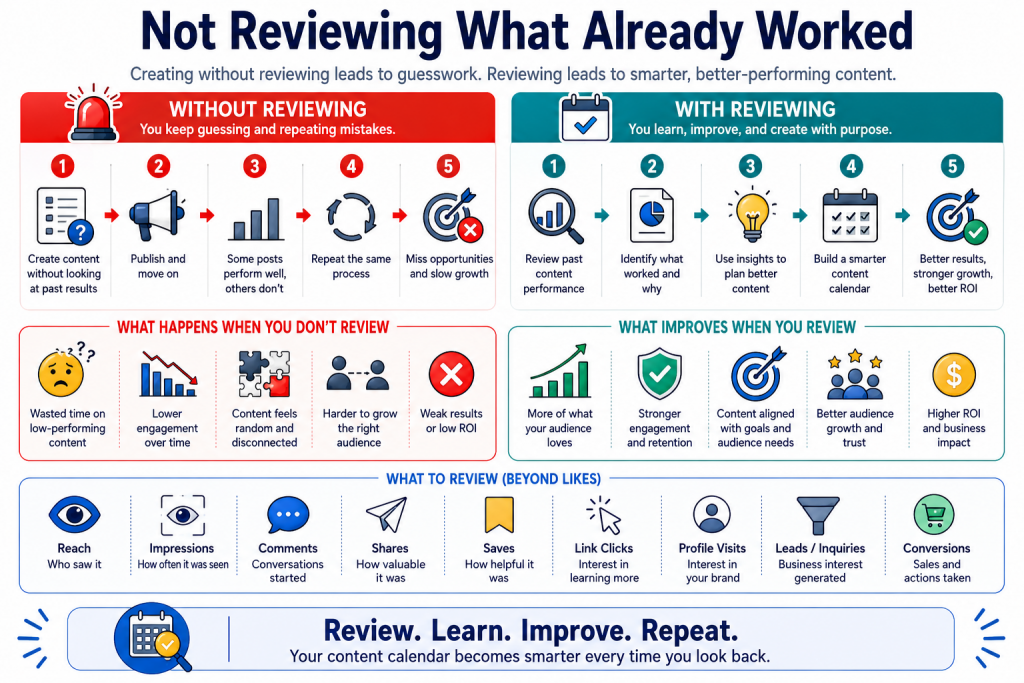
A strong content calendar should not only help you plan future posts. It should also help you learn from past posts.
Before planning your next month of content, take time to review your analytics. Look at which posts performed well, which formats worked better, which topics created engagement, which calls to action received responses, and which platforms delivered the strongest results.
But do not only look at likes.
Likes can be useful, but they do not always tell the full story. Depending on your goal, you may need to review reach, impressions, comments, shares, saves, link clicks, profile visits, leads, conversions, or follower growth. The right metric depends on what your content was supposed to achieve.
For example, if your goal is awareness, reach and impressions may matter more. If your goal is education, saves and shares may be stronger signals. If your goal is community, comments and conversations may be more important. If your goal is sales, clicks, inquiries, and conversions should guide your next decision.
This is how your content calendar becomes smarter over time.
Instead of asking, “What should we post next?” you can ask, “What has our audience already responded to?” Instead of guessing which topic might work, you can use performance data to decide what to repeat, improve, repurpose, or stop doing.
Your content calendar should be a living system. It should change as you learn more about your audience, your platforms, and your business goals.
When you review what already worked, your content planning becomes less random. You can create with more confidence, avoid repeating weak ideas, and build a content calendar that is guided by real performance instead of assumptions.
8. Managing Content in Too Many Scattered Places
A content calendar becomes harder to follow when your content lives in too many different places.
You may have captions written in Google Docs, visuals saved in folders, campaign notes buried in chat apps, approval comments sent through messages, and publishing schedules managed in spreadsheets. At first, this may feel manageable. But as your content grows, this scattered system can quickly create confusion.
You start asking the same questions again and again.
Where is the final caption?
Which image has been approved?
Did someone already revise the carousel?
Is this post scheduled for Instagram only, or also for LinkedIn and Facebook?
Who is responsible for publishing it?
Was the campaign date changed?
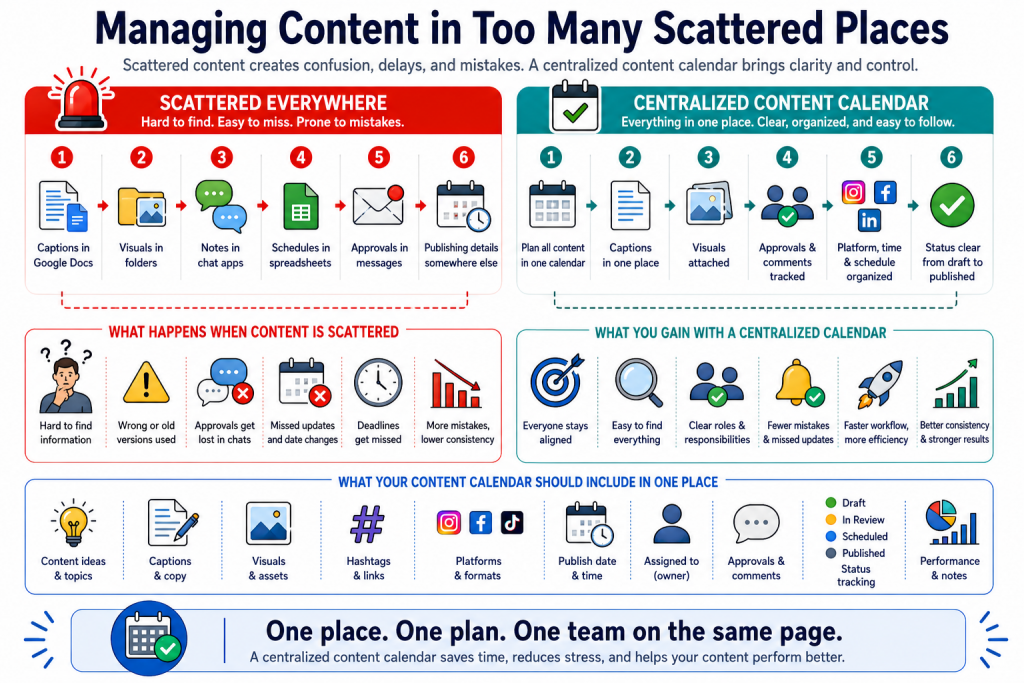
When your content workflow is spread across too many tools, small mistakes become easier to make. A team member may use the wrong version of a caption. A designer may update the visual, but the social media manager may not notice. A post may be approved in a chat thread, but the approval gets lost under newer messages. A publishing date may change in the spreadsheet, but not everyone sees the update.
This is how deadlines get missed.
The problem is not only disorganization. The bigger problem is that your content calendar stops being a reliable source of truth. Instead of helping your team stay aligned, your content calendar becomes just one more file among many other files.
A strong content calendar should make your workflow clearer.
It should help you see what content is planned, what is still being drafted, what is waiting for approval, what is ready to publish, and what has already gone live. When everything is easier to track, your team spends less time searching for information and more time improving the content itself.
This is especially important if you manage multiple platforms or work with a team. The more people involved, the easier it is for details to get lost. Writers, designers, marketers, founders, clients, and approvers all need visibility into what is happening.
Your content calendar should reduce confusion, not create more of it.
A good system helps you keep captions, visuals, schedules, platform details, and publishing status connected. It gives everyone a clearer picture of what needs to happen next. It also reduces the risk of posting the wrong content, missing approvals, or forgetting important deadlines.
If your content is scattered across too many places, your social media workflow will always feel heavier than it needs to be.
But when your content calendar becomes the central place for planning, organizing, and tracking content, your team can work with more clarity, fewer mistakes, and better consistency.
9. Building a Calendar but Not Following It
The final content calendar mistake is creating a plan that your team does not actually follow.
You may spend time building a content calendar for the month. You add post ideas, assign dates, prepare topics, and organize campaigns. Everything looks good at the beginning. But after a few days, the calendar is ignored. Captions are delayed. Visuals are not ready. Approvals take too long. Scheduled posts are forgotten. Eventually, your team goes back to last-minute posting.
This usually happens because the content calendar exists, but the workflow around it is unclear.
A content calendar only works when everyone knows what to do with it.
Who is responsible for writing the caption?
Who prepares the visual?
Who reviews the content?
Who gives final approval?
Who schedules the post?
Who checks if the post has been published?
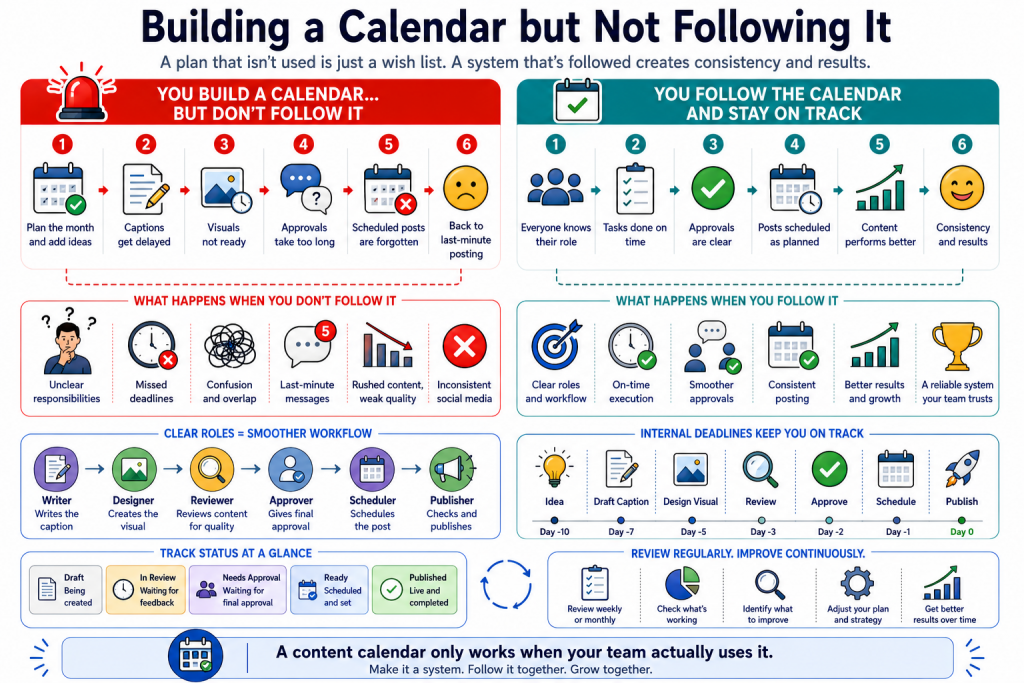
If these responsibilities are not clear, your content calendar becomes more like a wish list than a working system. You may have a plan, but no one is fully responsible for moving each post from idea to publication.
Deadlines also matter.
It is not enough to write the publishing date. Your content calendar should also include internal deadlines for drafting, designing, reviewing, approving, and scheduling. If a post needs to go live on Friday, the caption cannot be written on Friday morning, the visual cannot be reviewed one hour before posting, and approval cannot depend on someone noticing a message in a chat group.
A good content calendar gives your team enough time to work properly.
You also need a clear approval flow. Without it, content can get stuck. One person may think the post is ready, while another person is still waiting to review it. A founder may ask for changes too late. A client may approve the caption but forget to approve the visual. These small delays can affect the entire schedule.
This is why reminders and status tracking are useful. Your content calendar should help you know which posts are still in draft, which ones are waiting for approval, which ones are ready, and which ones have already been published.
Regular review is also important. A content calendar should not be created once and forgotten. You need to check it weekly or monthly to see what is on track, what needs to change, what performed well, and what should be improved for the next cycle.
When your team actually uses the content calendar, it becomes more than a document. It becomes a shared system for planning, creating, approving, publishing, and improving your content.
But when you build a content calendar and do not follow it, you end up with the same problem you were trying to solve: scattered work, missed deadlines, rushed posts, and inconsistent social media.
Your content calendar only becomes valuable when it becomes part of your team’s routine.
Conclusion: A Content Calendar Helps You Post With Purpose
Random posting makes social media feel heavier than it should.
When you do not have a clear content calendar, every post can feel like a last-minute decision. You need to think of an idea, write the caption, prepare the visual, choose the platform, check the timing, and publish before the opportunity passes. Over time, this kind of workflow can make social media feel stressful, inconsistent, and difficult to measure.
A content calendar helps you change that.
With a content calendar, you can plan your content with more intention. You can connect every post to a goal, organize your content pillars, prepare campaigns earlier, adapt content for different platforms, and review what already worked. Instead of posting just to stay active, you can start publishing content that supports your brand, your audience, and your business growth.
The goal is not to make your content process complicated. The goal is to make it clearer.
A strong content calendar gives you a better system for planning, creating, approving, publishing, and improving your content. It helps you reduce confusion, avoid rushed posts, and stay consistent without depending on daily improvisation.
But remember: a content calendar only works when it becomes part of your routine. It should be easy to access, easy to update, and easy for your team to follow.
That is where tools like Sociosight can help.
With Sociosight, you can organize your content ideas, schedule posts, manage multiple social media platforms, and review performance from one place. This makes it easier to turn your content calendar into a working system, not just another document your team forgets to open.
If your social media still feels chaotic, the problem may not be your creativity. You may simply need a better content calendar.
You can start building your content calendar with Sociosight’s free plan and explore how it helps you plan, schedule, and manage your social media in one place. When you are ready to manage content more seriously, you can upgrade to the lifetime subscription plan. Need more information? Schedule a demo or chat with us, and we will help you see how Sociosight can fit into your workflow.
Once your content calendar becomes clearer, your content becomes easier to manage, your team becomes more aligned, and your social media starts to move with more purpose.