

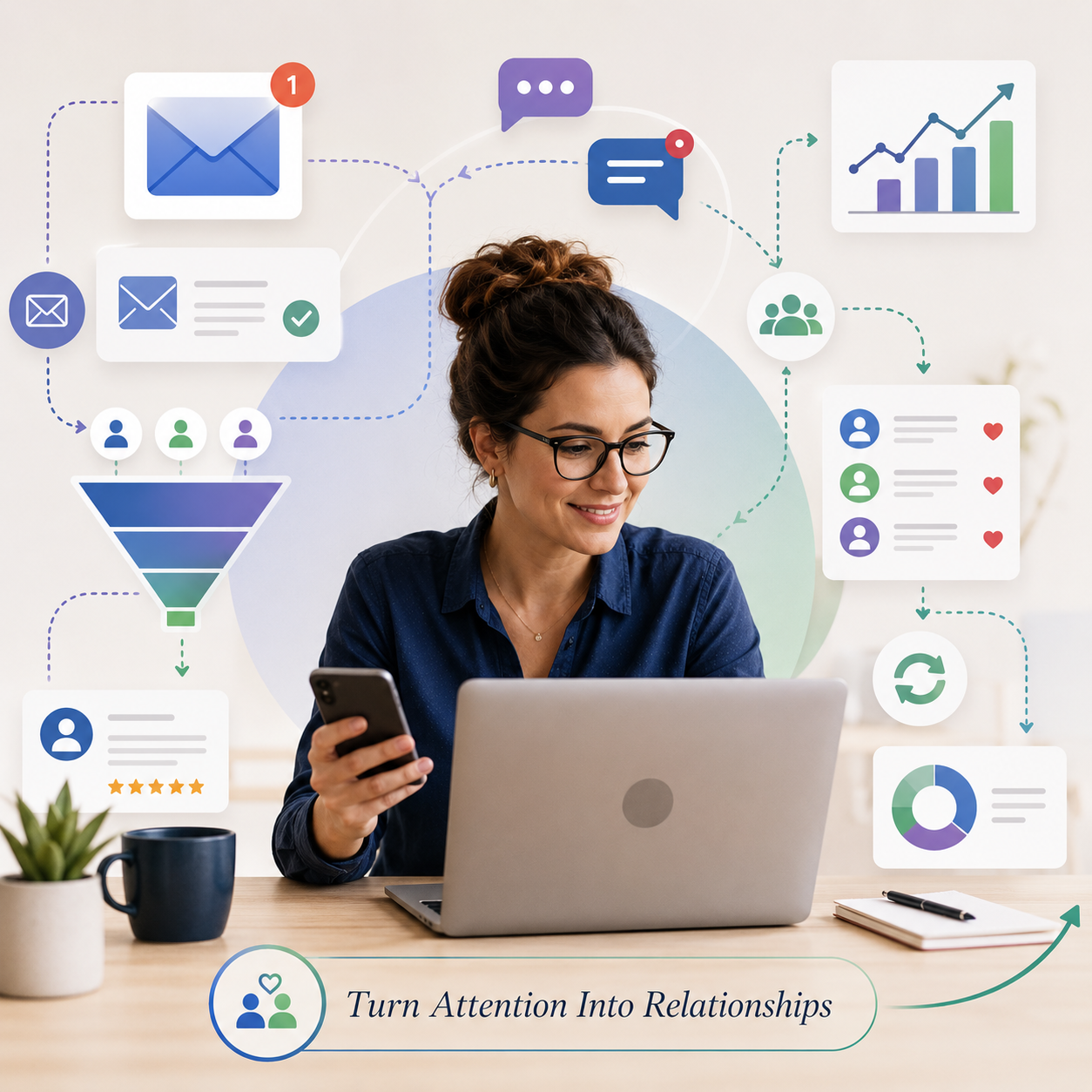

Most businesses do not have a traffic problem.
They have an email marketing and follow-up problem.
They spend money on ads. They post on social media. They run promotions. They try to attract new customers every month.
But after someone visits the website, follows the brand, asks a question, buys once, or shows interest, what happens next?
For many SMEs, the answer is: not much.
The customer disappears into scattered systems. One conversation stays in Instagram DM. One inquiry is buried in WhatsApp. One buyer never receives a proper email marketing follow-up. One happy customer never gets reminded to come back.
Then the business owner wonders why sales feel inconsistent.
This is the real issue.
Growth is not only about getting more people to notice your business. It is also about building a system that helps people remember you, trust you, and come back again.
For businesses that need a more advanced retention system, working with an email marketing agency can help turn scattered customer interactions into structured follow-up campaigns.
Do you struggle with managing multiple social media platforms for your brand's presence?
The Sociosight app can help you simplify the process and save you time. With Sociosight, you can publish, schedule, and monitor posts and engage with your followers across multiple social media platforms, all from one dashboard.
Get started today with a free sign-up!
Register Now for Free

But even when email is handled professionally, social media still plays an important role.
That is why email marketing and social media should not work separately.
Email marketing helps you follow up directly.
Social media helps you stay visible and build trust.
Together, they help your business create stronger customer relationships instead of depending only on expensive acquisition.
Why Email Marketing Matters More When Customer Acquisition Gets Expensive
For many years, business growth followed a familiar pattern.
Run ads. Get traffic. Convert customers. Repeat.
But that model is becoming harder to rely on.
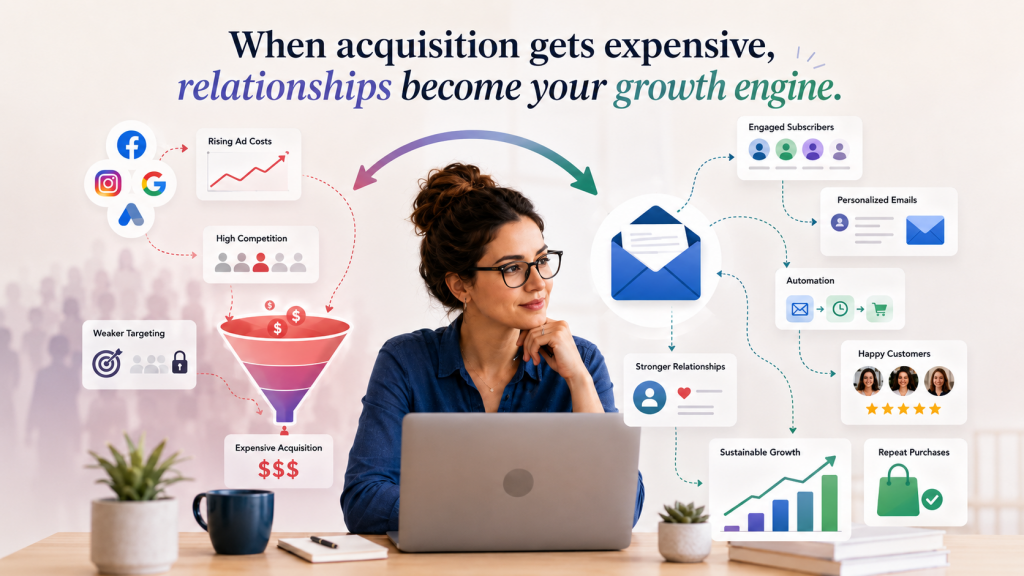
Customer acquisition costs keep rising. Paid ads are more competitive. Privacy changes have made third-party tracking weaker. Platforms are more saturated. Business owners are paying more to reach people who may not be ready to buy.
This is why email marketing is becoming more important.
When acquisition gets expensive, retention becomes more valuable.
Instead of only asking, “How do we get more new customers?” business owners also need to ask, “How do we keep the customers and leads we already have?”
That is where email marketing can become a growth engine.
Your email subscribers, past buyers, leads, and engaged audience are not random strangers. They already know your brand. They have shown some level of interest. Some may have bought before. Some may be waiting for the right offer, the right timing, or the right reminder.
With a strong email marketing system, you can continue the relationship after the first interaction.
Without it, many potential customers simply forget about you.
Table of Contents
Retention Is the New Growth Engine
Acquisition brings new people into your business.
Retention helps you increase the value of the people who are already there.
Both are important. But when paid acquisition becomes more expensive, retention becomes harder to ignore.
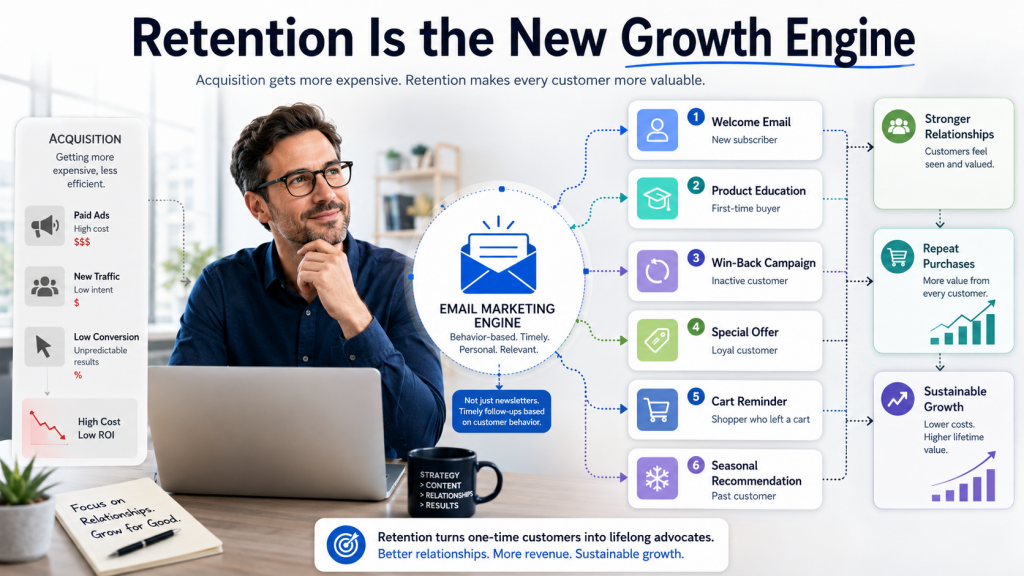
A repeat customer is usually easier to convert than a completely new customer. They already know your brand. They may already trust your product. They may only need a reminder, a useful message, or a relevant offer to come back.
This is why email marketing has become one of the most important channels for customer retention.
Modern email marketing is not just about sending newsletters. It is about creating timely follow-ups based on customer behavior.
For example:
A new subscriber receives a welcome email.
A first-time buyer receives product education.
An inactive customer receives a win-back campaign.
A loyal customer receives a special offer.
A shopper who leaves a cart receives a reminder.
A past customer receives a seasonal recommendation.
This kind of email marketing does not just chase sales. It builds a relationship.
And for SMEs, that relationship can become a more stable growth engine than constantly depending on ads.
Email Marketing Is Not Just About Sending Campaigns
Old-school email marketing often focuses on batch campaigns.
Write one email. Send it to everyone. Hope for the best.
But modern email marketing is moving toward smarter workflows.
The strongest brands are not only sending campaigns. They are building systems that respond to customer behavior.
This is where AI and automation are changing email marketing.
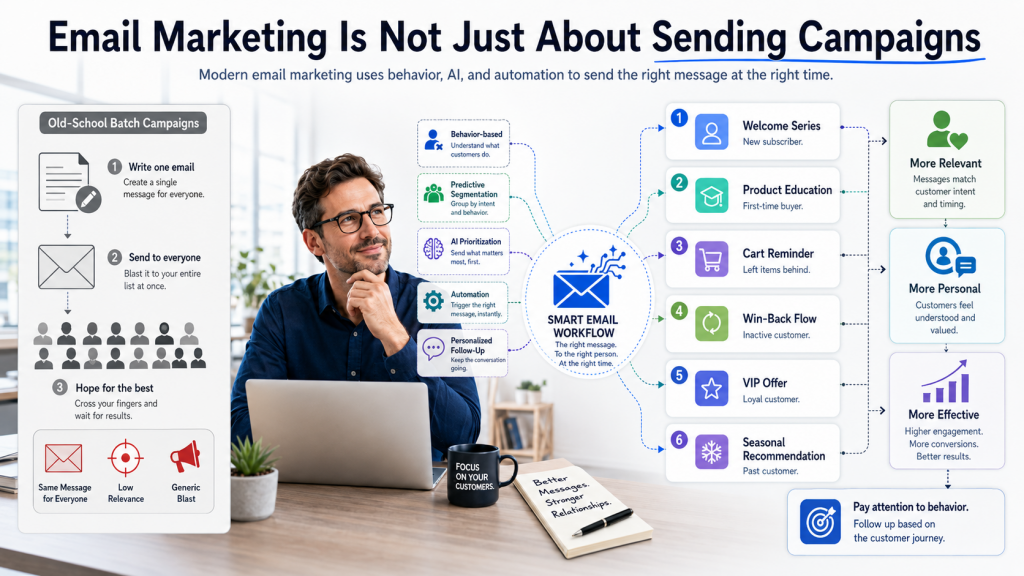
Instead of manually guessing who should receive what message, modern email marketing can use customer behavior to decide when to send a follow-up, what message to send, and which audience should be prioritized.
For larger ecommerce brands, advanced email marketing teams and agencies may use predictive segmentation, churn detection, AI workflows, and behavioral triggers to improve retention.
For SMEs, the idea does not need to be complicated.
The principle is simple:
Do not send the same message to everyone all the time.
Pay attention to behavior.
Follow up based on where the customer is in the journey.
This is what makes email marketing more relevant, more personal, and more effective.
Good Email Marketing Starts Before the Customer Leaves
Many businesses only try to win customers back after they have already disappeared.
But good email marketing starts earlier.
A customer may not leave suddenly. Usually, there are small signals.
They stop opening emails.
They stop clicking.
They stop browsing.
They stop engaging.
They stop buying.
Those small signals can show that the relationship is getting weaker.
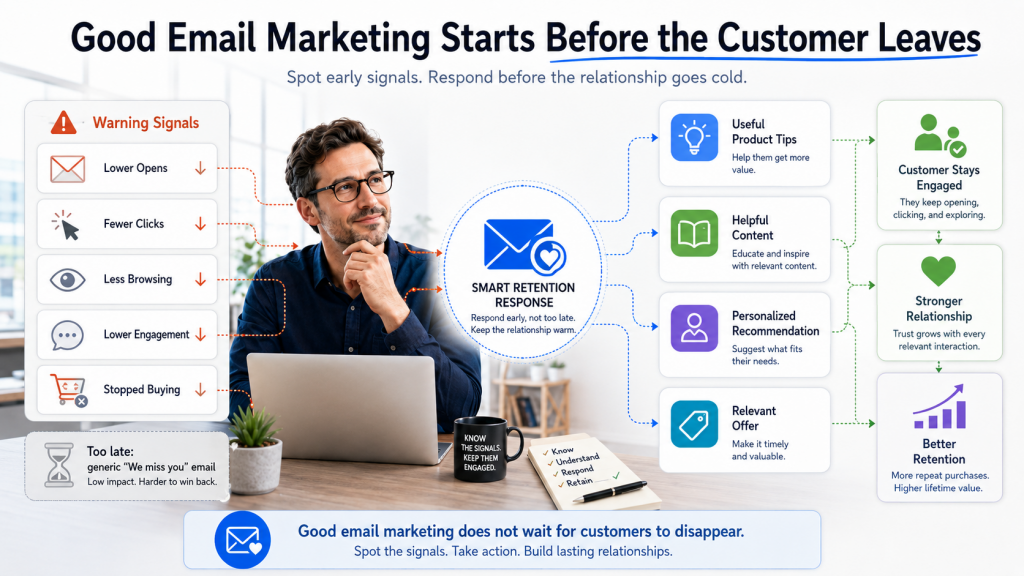
With a proper email marketing strategy, businesses can respond before the customer completely goes cold.
For example, instead of sending a generic “We miss you” email too late, a business can send useful product tips, helpful content, a personalized recommendation, or a relevant offer while the customer is still reachable.
This is where retention becomes more strategic.
The goal of email marketing is not only to react after sales drop.
The goal is to keep the relationship warm before the customer disappears.
Why Social Media Makes Email Marketing Stronger
Email marketing is powerful, but email alone is not enough.
Your customer does not experience your brand through one channel only.
They may discover you on Instagram, check your website, subscribe to your email list, read your content, ignore a few posts, open one email, then finally decide to buy weeks later.
That means your email marketing strategy should support your social media strategy, and your social media content should support your email marketing goals.
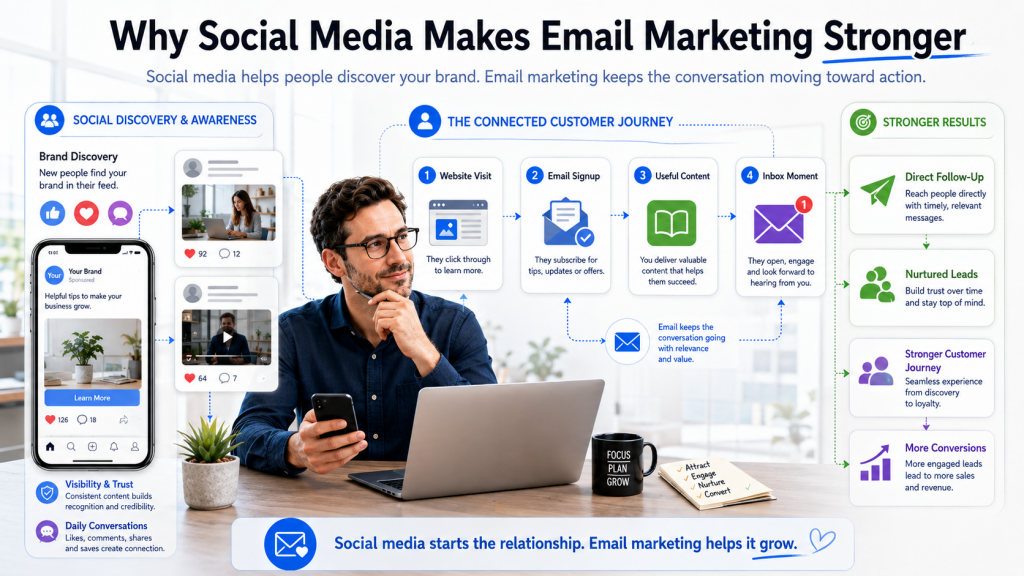
Social media helps people discover your brand.
Email marketing helps you continue the conversation.
Social media builds visibility and trust.
Email marketing creates direct follow-up.
Social media keeps your brand present in daily conversations.
Email marketing helps move interested people closer to action.
When both channels work together, your business creates a stronger customer journey.
Email Marketing Should Be Part of an Omnichannel Follow-Up System
Email is powerful, but email alone is not enough.
Customers move between channels. They may see your content on Instagram, receive an email, check your website, watch a video, read reviews, and return later through another channel.
So your email marketing should not work in isolation.
It should be part of an omnichannel follow-up system.
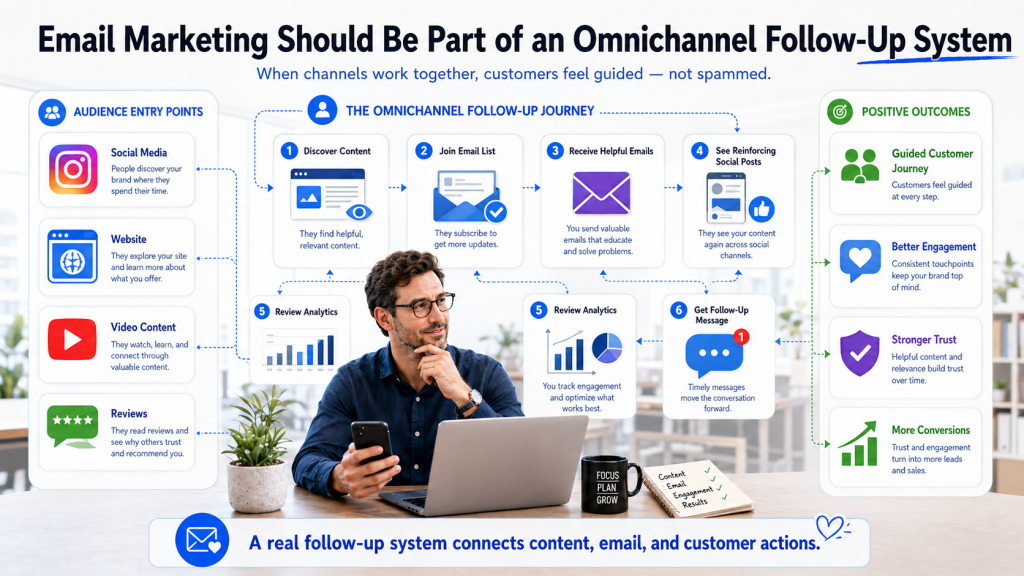
For SMEs, this does not always mean using complex enterprise software. It can start with a simple structure:
Use social media to attract and educate your audience.
Use content to invite people to join your email list.
Use email marketing to nurture leads and customers.
Use social media to reinforce the same message.
Use analytics to see what content and campaigns perform best.
Use follow-up messages to bring people back.
When every channel works together, your customer feels guided, not spammed.
That is the difference between random marketing and a real follow-up system.
The Problem: Many SMEs Manage Email Marketing and Social Media Separately
For many small businesses, the biggest issue is not lack of effort.
It is lack of system.
Social media captions may be written in one document. Visuals may be saved in different folders. Posting schedules may be managed manually. Customer questions may come through Instagram, Facebook, WhatsApp, and email. Analytics may only be checked when someone has time.
Meanwhile, email marketing may be handled separately, without a clear connection to social media campaigns.
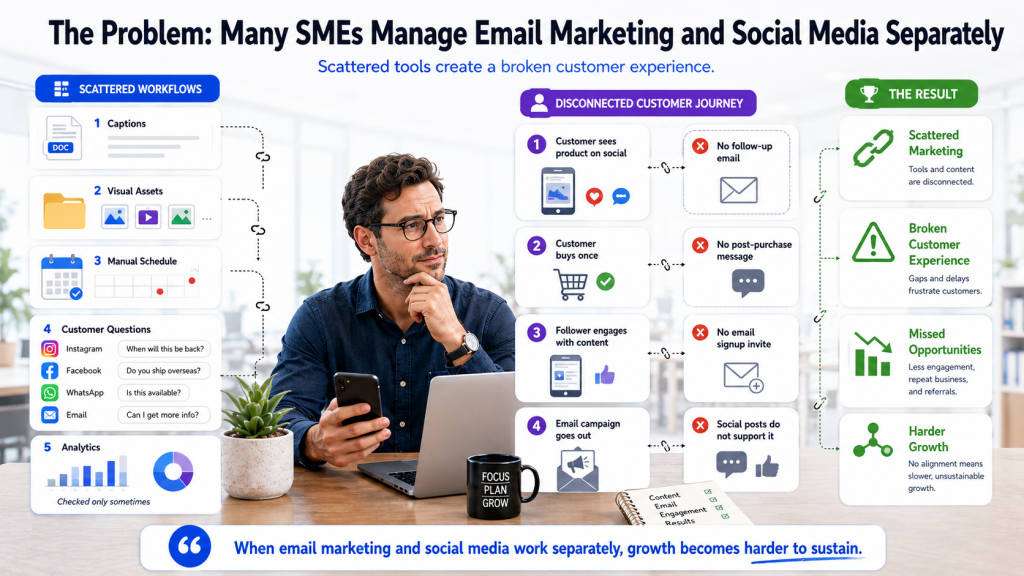
This creates a broken customer experience.
A customer sees a product on Instagram, but receives no follow-up.
A buyer purchases once, but never gets a post-purchase email.
A follower engages with content, but is never invited to join the email list.
An email marketing campaign promotes something, but social media does not support the same message.
The result is scattered marketing.
And scattered marketing makes growth harder.
Email Marketing and Social Media Should Work as One Follow-Up System
A better approach is to treat email marketing and social media as one connected follow-up system.
Here is a simple example.
Your social media content attracts attention.
Your post invites people to visit your website, download a guide, register for an event, or join your email list.
Your email marketing sequence follows up with helpful information, product education, offers, or reminders.
Your social media continues to reinforce the same message with testimonials, tips, behind-the-scenes content, or campaign updates.
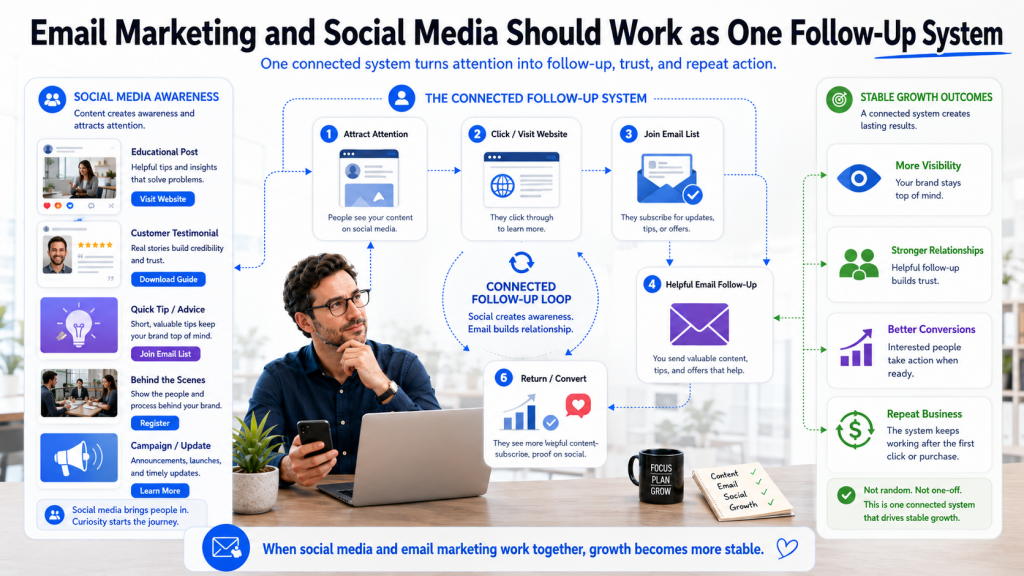
Your email marketing brings interested people back when they are ready.
This creates a loop.
Social media creates awareness.
Email marketing builds relationship.
Social media keeps your brand visible.
Email marketing supports conversion and retention.
For business owners, this is where real growth can become more stable.
You are no longer depending only on new traffic. You are building a system that keeps working after the first click, first follow, or first purchase.
Acquisition vs Retention: Why Business Owners Need Both
It would be wrong to say acquisition no longer matters.
Every business still needs new customers.
Paid ads, SEO, social media, partnerships, and referrals can all bring new people into your business.
But acquisition alone is not enough.
If your business keeps attracting new people but fails to follow up, nurture, and retain them, you are leaking growth.
This is why email marketing matters.
Acquisition gives you traffic.
Email marketing helps you nurture that traffic.
Acquisition brings new possibilities.
Email marketing helps turn those possibilities into repeat engagement and repeat sales.
Acquisition creates first-time buyers.
Email marketing helps turn them into returning customers.
The strongest businesses do not choose between acquisition and retention.
They build both.
But when acquisition costs rise, retention often becomes the more profitable place to improve first.
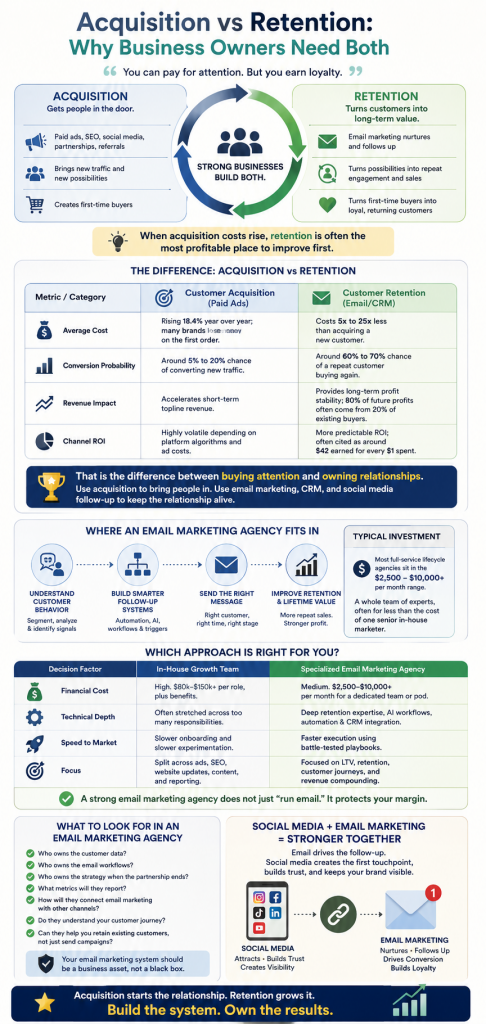
Here is a simple comparison between customer acquisition and customer retention:
| Metric / Category | Customer Acquisition (Paid Ads) | Customer Retention (Email/CRM) |
| Average Cost | Rising 18.4% year over year; many brands lose money on the first order. | Costs 5x to 25x less than acquiring a new customer. |
| Conversion Probability | Around 5% to 20% chance of converting new traffic. | Around 60% to 70% chance of a repeat customer buying again. |
| Revenue Impact | Accelerates short-term topline revenue. | Provides long-term profit stability; 80% of future profits often come from 20% of existing buyers. |
| Channel ROI | Highly volatile depending on platform algorithms and ad costs. | More predictable ROI; often cited as around $42 earned for every $1 spent. |
That is the difference between buying attention and owning relationships.
Paid ads can still work. But they should not be the only core of your growth plan.
The better approach is to use acquisition to bring people in, then use email marketing, CRM, and social media follow-up to keep the relationship alive.
Where an Email Marketing Agency Fits In
For businesses that rely heavily on ecommerce, subscriptions, online sales, or repeat purchases, working with an email marketing agency can help build a stronger retention system.
A specialized email marketing agency can help with customer segmentation, automated flows, campaign strategy, copywriting, testing, analytics, and customer lifecycle planning.
A good email marketing agency does not only send emails. It helps you understand customer behavior and create smarter follow-up systems.
Some advanced agencies also use AI, predictive segmentation, and customer behavior data to identify when someone may stop engaging. This allows brands to send better messages before the customer disappears.
This is where modern email marketing becomes more strategic.
It is not about blasting everyone with the same promotion.
It is about sending the right message to the right customer at the right stage of the relationship.
Most full-service lifecycle agencies sit in the $2,500 to $10,000+ per month range on retainer. That usually gives you access to strategists, copywriters, automation specialists, and developers working together as one unit, often for less than the cost of hiring one senior in-house marketer.
Here is a simple comparison:
| Decision Factor | In-House Growth Team | Specialized Email Marketing Agency |
| Financial Cost | High. $80k–$150k+ per role, plus benefits. | Medium. $2,500–$10,000+ per month for a dedicated team or pod. |
| Technical Depth | Often stretched across too many responsibilities. | Deep retention expertise, AI workflows, automation, and CRM integration. |
| Speed to Market | Slower onboarding and slower experimentation. | Faster execution using battle-tested playbooks. |
| Focus | Split across ads, SEO, website updates, content, and reporting. | Focused on LTV, retention, customer journeys, and revenue compounding. |
A strong email marketing agency does not just “run email.”
It protects your margin.
But even if you work with an agency, your social media presence still matters. Email may drive the follow-up, but social media often creates the first touchpoint, builds trust, and keeps your brand visible between email campaigns.
What to Look For in an Email Marketing Agency Partner
If you decide to work with an email marketing agency, choose carefully.
A strong agency should not only focus on open rates or beautiful email designs. They should understand business growth, customer retention, revenue, and long-term customer value.
Before choosing an email marketing agency, ask:
Who owns the customer data?
Who owns the email workflows?
Who owns the strategy when the partnership ends?
What metrics will they report?
How will they connect email marketing with other channels?
Do they understand your customer journey?
Can they help you retain existing customers, not just send campaigns?
This is important because your email marketing system should become a business asset.
It should not become a black box that only the agency understands.
The best agency partners help you build a system that your business can continue to benefit from.
But Email Marketing Alone Will Not Fix a Weak Social Media Presence
Even if you work with an email marketing agency, your social media still matters.
Why?
Because social media is often where the relationship begins.
People may see your brand on Instagram, Facebook, TikTok, LinkedIn, Pinterest, or YouTube before they ever join your email list.
If your social media presence is inconsistent, unclear, or disconnected from your campaigns, your email marketing will have less support.
Your audience needs repeated signals of trust.
They need to see that your brand is active.
They need to understand what you offer.
They need to recognize your voice, values, and message.
That happens through consistent social media content.
So while email marketing helps you follow up directly, social media helps you stay discoverable and memorable.
The two channels should not compete.
They should work together.
How Sociosight Helps Support Your Email Marketing Strategy
Sociosight is not an email marketing platform.
Sociosight is a social media management software.
But this is exactly why it can support your email marketing strategy.
Because before people subscribe, buy, or respond to your emails, many of them first interact with your brand through social media.
With Sociosight, SMEs, marketers, freelancers, and agencies can manage social media more consistently from one place.
You can plan content, schedule posts, manage multiple social media profiles, review analytics, and use AI writing assistance to create better content ideas and captions.
This helps your social media become more organized.
And when your social media is more organized, it becomes easier to support your email marketing campaigns.
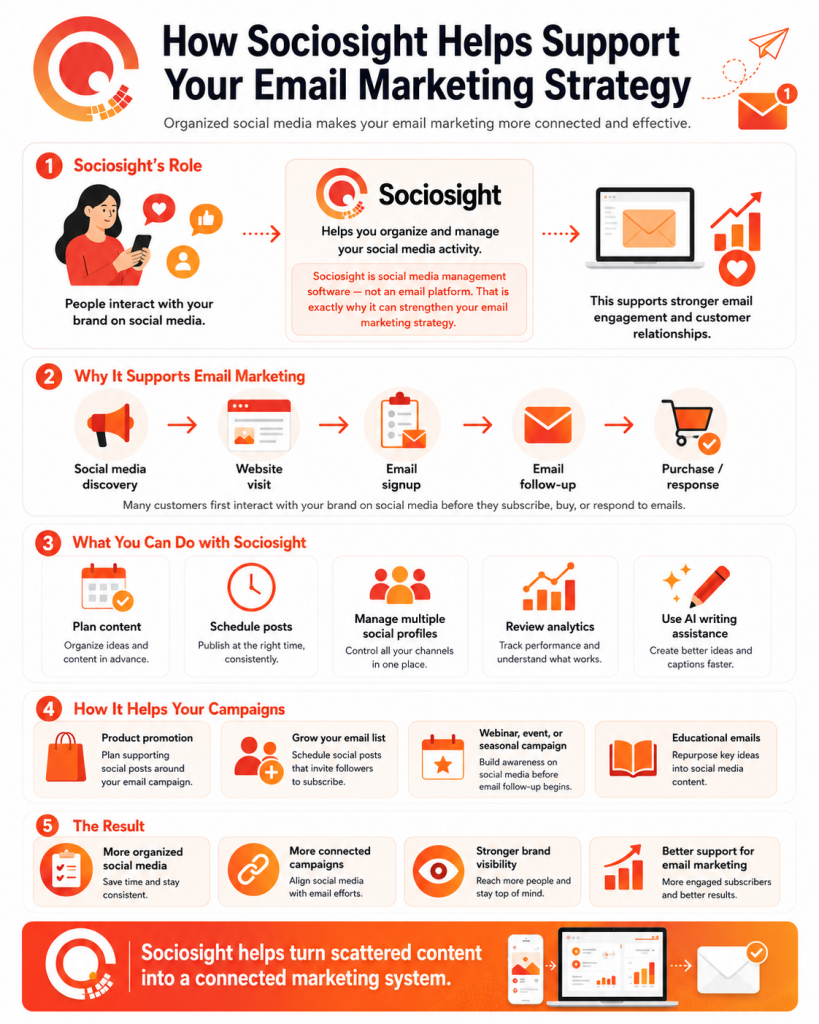
For example, if you are launching an email marketing campaign for a product promotion, you can also plan social media posts around the same campaign.
If you are growing your email list, you can schedule posts that invite followers to subscribe.
If you are running a webinar, event, or seasonal campaign, you can use social media to build awareness before your email marketing follow-up begins.
If you are sending educational emails, you can repurpose some of the same ideas into social media content.
This makes your marketing more connected.
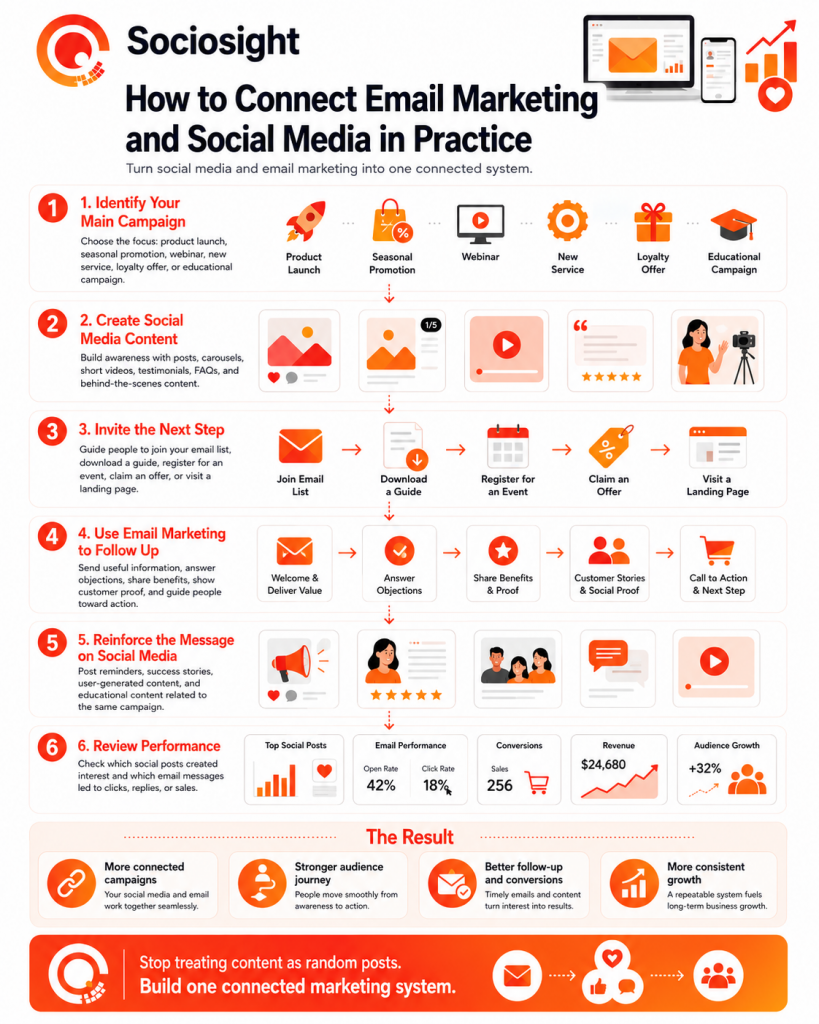
How to Connect Email Marketing and Social Media in Practice
Here is a simple workflow business owners can apply.
First, identify your main campaign.
This could be a product launch, seasonal promotion, webinar, new service, loyalty offer, or educational campaign.
Second, create social media content that builds awareness.
Use posts, carousels, short videos, testimonials, FAQs, and behind-the-scenes content to introduce the topic.
Third, invite people to take the next step.
This could be joining your email list, downloading a guide, registering for an event, claiming a special offer, or visiting a landing page.
Fourth, use email marketing to follow up.
Send useful information, answer objections, share benefits, show customer proof, and guide people toward action.
Fifth, use social media again to reinforce the message.
Post reminders, success stories, user-generated content, or educational content related to the same campaign.
Sixth, review performance.
Check which social media posts created interest and which email marketing messages led to clicks, replies, or sales.
This simple structure helps business owners stop treating content as random posts and start using social media and email marketing as one system.
Email Marketing, Social Media, and AI: What Comes Next
Marketing is becoming more data-driven and more automated.
Modern email marketing can use AI to personalize messages, predict customer behavior, recommend products, and improve timing.
Social media tools can also use AI to support content ideation, caption writing, scheduling, and performance analysis.
For SMEs, this does not mean replacing human creativity.
It means reducing manual work.
It means helping business owners and small teams stay consistent without feeling overwhelmed.
A business owner should not have to guess every caption, every email topic, every posting time, or every follow-up message manually.
With the right system, AI can help you work faster while your brand still keeps its human voice.
That is why the future of email marketing and social media is not about choosing one channel over another.
It is about creating a smarter customer communication system.
Final Thoughts: Email Marketing Works Better When Your Social Media Is Consistent
Email marketing is one of the most powerful ways to build customer relationships.
But it works even better when your social media presence is consistent, clear, and connected to the same customer journey.
For business owners, the message is simple.
Do not only chase new customers.
Do not only post and hope people remember you.
Do not only send emails when you want to sell.
Build a system.
Use social media to stay visible.
Use email marketing to follow up.
Use both channels to build trust, retention, and repeat business.
And if your social media feels scattered, Sociosight can help you bring more structure to your workflow.
With Sociosight, you can plan, schedule, and manage your social media content more consistently, so your brand can support every stage of the customer journey — from first discovery to long-term loyalty.
Because in today’s market, the businesses that grow are not always the ones shouting the loudest.
They are the ones that know how to stay connected.